|
|
|
|
You are viewing: Main Page
|
|
December 5th, 2022 at 05:19 pm
I was just approved for a new credit card with a big $300 upfront bonus (redeemable for gift cards) after you spend $1,500 in the 1st 3 months. That's a bit of a challenge, but I've done it before. I had to temporarily lift the freeze on my 3 credit bureau accounts before applying. To be sure I can do it, I'll now exclusively use this one card for the next 3 months, or until I reach the target spend.
At the same time, I just activated an offer by another of my existing cards where you earn a $15 statement credit after charging $75 at grocery stores by end of January. Easy peasy.
Unfortunately, amid all the inflationary price increases we've all been seeing, my electricity and income tax bills will have big price jumps very soon.
I still have just one person left to buy a Christmas present for, and she's usually the easiest, so I really need to get to my favorite local gift shop and do that very soon as I'll have to ship the gift to her, along with one other cousin. I hate spending money on shipping, but i wanted to wrap both gifts, so....
I recently had a nice dinner out with a friend at a newish Indian restaurant. I liked it very much. Afterwards, we walked down Main St. to admire the luminaria candles that were lit in little white paper bags and to view the 2 Christmas trees that were officially lit earlier that night to mark the start of the holiday season.
Posted in
Uncategorized
|
2 Comments »
November 29th, 2022 at 04:11 pm
Greetings, all.
I'm feeling very happy that after my Internet bill rose from $39 to $52 due to 2 promotions expiring, the rep on the phone was not only able to lower my bill, but to reduce it further, to just $32 a month, a price that will be good for 1 year. (I know that many of you are going to tell me you pay much more.  ) )
That feels like a minor miracle, given how everything is going up in price these days.
However, I have so many looming big expenses coming up, just at a time when my income is shrinking (due to lack of work from employer). These expenses include about $650 in car maintenance (I will use my AAA member 10% discount at the car dealer); half of my annual property taxes, $3,383, due by the end of December; my estimated Q4 federal and state income tax (due Jan 15) and, down the road, the possibility of needing 1 or 2 crowns for cracked teeth, to the tune of up to $3,200. That one's not a definite, at least for right away, but something to keep on my radar.
Guess I'm gonna have to tackle the car maintenance first. I had tried getting a price from the local station near me, but they failed to call me back as promised, so eh. They don't accept the AAA member discount, nor do they have anywhere for you to sit and wait, which is likely what I'll have to do. So the dealer it is.
I am still spending time with M., the man I met online back in September. I usually see him every week, but he's very frugal, like I am, so aside from that first time we met at a riverfront restaurant, he usually has me over for dinner, or vice versa, and sometimes we do food shopping trips to outlet stores, Asian and Indian markets and the organic farm stand in Millerton.
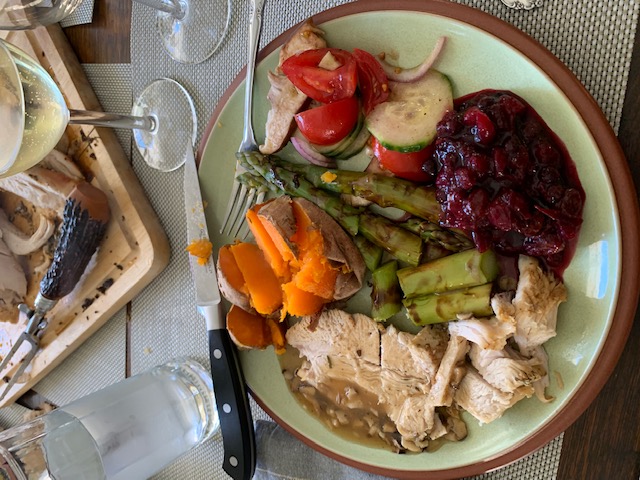
He and I cooked a wonderful Thanksgiving dinner for us and my dad at his place. It was probably the best Thanksgiving dinner I ever had. I made a really good cranberry-blueberry salsa and vegan ice cream for dessert, and his turkey (I got it for free from BJs) with mushroom gravy was the best. However, we forgot to put the stuffing on the table and so that was a bust.
He didn't want any of the leftover turkey as his fridge was packed, so I took it all home and made turkey soup a day or two later.
I'm pleased to report that my Christmas shopping is almost done. I only bought for 5 people; I will have to pay additional shipping to mail presents to my 2 cousins, and of course my father will complain that I bought him anything at all, but he will be getting a pair of slippers. M. is (agnostic) Jewish and he's a big foodie like me, so I was thinking what fun it would be to buy him small gifts for each day of Hanukkah, but he said no, that's just for the kids. Nevertheless, I got him several things for the kitchen, including a much-needed knife sharpener, a large bamboo cutting board, a silicone garlic roll and a mushroom jerky sampler (delicious). I'll also be making bird treats for him to put in his feeders and hang from his trees. Plus some "Men Don't Stink" soap.
Luther and I went to see a new vet this week; I had a copy of his chest x-ray from last year, a video of Luther having a coughing fit and the other vet's records. This vet said that asthma and lung cancer look very similar on film but that treatment would be the same, steroids to reduce inflammation. I know Luther's days are numbered. At 16, though, he's doing okay, and the meds are making him eat more, which is a good thing becus he's always been a fussy eater and his weight had dropped from 10 lbs to 8.something. The steroids have reduce the coughing fits, from 3 or 4 times a night to just 1 that I'm aware of. We will need to taper down, though, so I hope his improvement lasts with the reduced dose.
Yesterday I got the tree up and piles of Christmas decorations out, many of which have memories of loved ones no longer here. Hung the big wreath above the garage, so it's the first thing you see when you come up the driveway. Right now I'm recharging batteries for the candles that go in my windows.
Posted in
Uncategorized
|
3 Comments »
November 15th, 2022 at 02:02 pm
Mouse in House
I noticed my last entry here was about a mouse, and, well, I seem to be repeating the mouse tales since the weather has suddenly turned cold after a very warm autumn. I had 2 traps set behind a little secret door to nowhere at the top of my basement stairs; I can always reliably catch mice there cus it's right next to the furnace flue, and its warmth attracts the mice.
I noticed the other day that one of the traps was missing, and I peered around a pillar as far as I could crane my neck, but couldn't find the mouse or trap, but now I know for sure it's somewhere as I'm noticing the smell in my office, directly above, and also the downstairs hall off the kitchen, right next to the same area. I'll have to investigate again, this time with a stick or something.
Portfolio Scary to Behold
Well, compared to a year ago, my overall portfolio is down about $131,000, and that's being pretty conservatively invested, 50/50 stocks/bonds. I'm trying not to do any unnecesssary spending...
Job Woes
...but the fact is, I've been living partly on savings for day to day expenses due to the fact my p/t Indian job, which I've had since August, is giving me maybe 9 hours of work on average each week when it was supposed to be 20. I did ask them for 2 things: 1. to let me know on those days when they won't have any work for me, and 2. to honor my 2 days off, days they assigned to me. Not doing either one has wreaked havoc on my personal life as I'm afraid to go off and run errands or do other things if I think they may send me work. I need to turn it around in 24 hours, so I Iike to get on top of it quickly.
After I complained about it (nicely), they are still doing exactly the same thing, and they never did respond to my original complaint! Yes, I'm looking for other work to either supplement or replace this job, but the fact is, it's difficult to find p/t work at the rate of pay I'm earning, and I won't return to f/t work. I may just need to stick it out for another 1.75 years until I pick up Medicare. My old employer, the pharma agency, has said I'd be their first choice to to hire back if work picks up, but I'm not counting on anything.
Miscellaneous Saving Opportunities or Scores
In the meantime, I'm always on the lookout for opportunities to save money somehow. My US Bank card is offering 20% cash back on any spending between now and year's end. I'm preparing to apply for a Capitol One $200 cash back bonus card, but one of my credit bureau acounts is inaccessible and I need to unfreeze all 3 before I apply.
I was able to sell about $1750 (that's net of 30% commission) of my mother's art through a local gallery in recent months, much of it to a single person who truly has become a "patron" of my mother's art.
By spending $150 at BJs during a certain time period (not much more than I'd usually spend), I scored a free turkey, which I'll be picking up at the end of the week. I am still eating largely vegetarian, but the man I've been spending time with has offered to cook a late Thanksgiving dinner for me and dad a few days after Thanksgiving, so I am giving him the turkey as I'll never want to eat that much turkey; I may ask for some leftovers to make turkey soup, but that's it.
Gushing About Garlic
Now that we've had a hard frost, I was able to heavily mulch my garlic with a layer of leaves for winter protection; I had one last spare piece of plastic fencing (I routinely use plastic fencing to deter deer from nibbling my rhododendrons and mountain laurel), and I lay the fencing over the leaves on the raised bed; it nicely covered about 90% of its length and should keep the leaves from blowing away in heavy winds.
I maybe tried growing garlic once a long time ago, and decided to give it another shot with a hardneck variety from Spain. Most of my leaf raking is done, and my attached garage is stuffed with overwintering annuals like geraniums, lantana, gazania daisies, nasturtium, mint, coleus, angel wing begonia and a fig tree seedling I have high hopes for.
I've decided it's better for me to park the car in the driveway during a snowstorm, because I can park it further down the driveway, saving myself a good 20 feet (or more, if I park on the slope) of snow shoveling. So I'l be able to avoid opening up the big garage door, and I've got a large window on the south side that lets in a lot of light. I water lightly, like once every few weeks or less.
Connection From the Past
Those of you who know me from years ago may remember my frequent mentions of my old friend R., who died maybe 3 or 4 years ago. Some time ago, I joined a Facebook Slovak genealogy group, although I am not actively doing family tree research right now. I came upon a post by someone in the Slovak group who shared R.'s last name and seemed to live in my area. I left a comment on his post, and sure enough, it's a cousin who said he wil PM me soon. I am curious to learn who he is; R. mentioned his extended family from time to time, but I don't remember any specifics.
Posted in
Uncategorized
|
3 Comments »
December 24th, 2021 at 04:13 pm
Winter is mousetrap time, and yesterday I noticed one of 2 traps I have in the basement is entirely gone. I know a mouse was caught in it, but it's nowhere to be found. I can clearly here when the traps go off, usually early evening, after the darkness and cold have set in. Very wierd. Same thing happened this morning with the other trap, although in that case, I found the trap...empty. They are getting very good at escaping.
Remember in my last post my belief that you can get around the "too many credit card offers applied for" scenario by applying for more than one credit card on the same day? I was wrong. I got the explanation from one of the two card offers I was turned down for. I was turned down because I had already applied for the Wells Fargo card. I should get the Wells Fargo card soon, and then, happy charging toward the $200 bonus.
Speaking of charging, I did go on a bit of a spending spree for myself. My father gifts each of his kids money, and so I spent only a very small portion of it, about 5% of it.
You see, I've reached a certain point in life. For many decades, i've just naturally been frugal. Well, probably because I HAD to. I most often shopped with the final price being an important, if not the most important factor in making the purchase. Now, I want to treat myself a bit better, where it counts.
So I purchased some very nice Pottery Barn percale sheets, plus some other sateen sheets elsewhere. (I want to compare them and see which I like better.) Both cost substantially more than the bargain-basement sheets (often flannel) I would usually buy at some place like WalMart or Target. I am really looking forward to sleeping in some quality sheets.
I also very recently bought a nice gray chunky big weave cotton blanket. In addition, I have a very nice Pottrery Barn coverlet I bought about 3 years ago which has still yet to be used (!), as I knew the cat would sharpen his claws on it. I figured he is 15 years old, and that I would wait. He's still hanging in there.
The other thing I've been spending on is cute jeans/straight leg pants. Ever since I lost weight and found I wear a size 6 pant, I've been stocking up on whatever strikes my fancy. ..torn jeans, frayed hem jeans and other little embellishments. I love them all.
A much larger expense was another tree takedown, a towering white pine in my front yard. Now I can rest a little easier when the next storm arrives. I'll need to clear out all the weeds that were growing under the canopy, and now I have a roughly 25-foot diameter space to plant more pollinator perennials and shrubs. There's already a doublefile viburnum and a Japanese maple sapling in there that I will leave, but everything else will go: mostly poison ivy, some black locust saplings and mile-a-minute vine.
Wednesday I had my friend R. and her dog over for a glass of wine; she brought a bunch of her gorgeous and delicious Christmas cookies.

Yesterday I took my dad out for breakfast at Chip's. Today, Christmas eve, happens to be my friend D.'s birthday, and she is recovering from hip replacement surgery, so I told her I'd be over there with some cookies I made for her. I also brought her some homemade split pea soup last week. I won't be doing anything special for Christmas until end of day, when the new man I'm dating comes over. I knew he'd be spending the day with his family, so I suggested he enjoy his time with them, then swing over here when he's done.
Happy holidays, everyone!
Posted in
Uncategorized
|
3 Comments »
December 18th, 2021 at 05:31 pm
Things are going along swimmingly.
I have not yet done my year-end reports on spending/income, but will do soon.
Today I noticed while paying a credit card bill online that they had already preapproved me for one of their new cards, which came with a $100 bonus. I was going to go for it, but then figured I may as well check creditcards.com to see if I could find a card with a higher bonus. I did, a Wells Fargo card that gives you $200 bonus after a $1K spend in first 3 months. Of course, I had to temporarily lift my credit freeze at all 3 bureaus first. Anyway, I was approved. My credit is in the Excellent category.
I think I had read somewhere that it takes a day or two for a credit check to show up on your credit reports, so I thought I would apply for a SECOND card, soley for the bonus offer, especially since I noticed there was a Citi offer where you only had to spend $750 in the first 3 months, and I was confident I could hit the spend targets of both cards.
Unfortunately, I was denied the 2nd credit card application, and then a 3rd. So maybe what I thought I'd heard about the delay in credit checks showing up in your report was untrue.
Well, anyway, happy to get the Wells Fargo card.
Today is a rare day when I have nothing in particular I really have to do, plus the weather's a bit dismal, so I'm enjoying posting here.
I've been dating someone new for about the past 4 or 5 weeks now. He lives kind of far away (about 55 min) so I've only been seeing him once a week. He's a retired pharmacist (not in retail setting, in a hospital). We seem to have a lot in common including hiking, biking, kayaking and a love of travel.
Now that my knee is about 90% better, I think we've hiked every time we've met (except the 1st time, when we met at a Panera's).
It's kind of nice that my cousin, who's a few years older than me and widowed, ALSO met someone and will probably end up marrying him She actually knew him for 20 years as he works at the same engineering firm she's worked at since high school. He was more recently widowed. She told me she never expected to find love again. She's very happy, and he's whisking her away to see different concerts every week, Bocelli being the most recent one. So we are like 2 teenagers comparing notes, although they are about 6 months ahead of us.
I bought some matcha tea a while ago, and decided to make some today. Boy, was it awful. So bad, in fact, that it made my stomach unsettled and nauseous. I had to eat some crystallized ginger. Ugh. Might try again in a smoothie with other stuff, but definitely not straight. I would like to learn to love matcha, the way I did tinned sardines, for the health benefits.
My Christmas shopping was all done a while ago, and just one more thing to wrap.
I'm VERY happy to report I've returned to near daily walking for exercise, weather permitting. Tomorrow I'll make a split pea soup for the week ahead.
Posted in
Uncategorized
|
5 Comments »
October 16th, 2021 at 03:38 pm
Knee Surgery Recovery Continues
I'm happy to report I am starting to make real progress in recovering from knee surgery. I had 2 visits so far with the physical therapist, and I noticed a significant improvement after the very first session!
He did some massage and a lot of pressing down on my knee (I can't straighten out the leg completely), and while it was kind of painful, it seems to have jump-started something and I left there feeling much more flexible in the leg. And since then, I've been able to walk upstairs normally (I still do one step at a time going down as that's a bit too much of a stretch). I am also walking more normally, though I still have a ways to go yet.
Someone from my Buy Nothing group gave me a stationery bike, and while it's an oldie, it does what I need it to do: let me cycle, starting with little to no resistance. However, she couldn't bring it up my outdoor stairs herself, and since I couldn't help her, she put it in my garage for me, so that's where I go now to use it. Luckily, this fall has been very warm and comfortable, so it's actually nice to go out there and do it, but when it turns cooler tomorrow, I'll just bundle up more.
I have just 4 more PT sessions left and I hope it's enough. There's still quite a bit of swelling in and around the knee and I have been icing, but without a proper gel pack, which I ordered on Amazon and which should be arriving tomorrow.
Garden & Yard Work
You'll be happy to know I was able to fling the deer bones with a shovel last week into the woods and off my lawn. And since the weather has been divine for the past few weeks, I have also been doing a bit of yard work, slowly and not much.
I did move a Dark Knight Bluebeard which I spent a fair amount of money on last spring to a better, sunnier location. It was completely shaded out by my amsonia. I don't think it liked being moved as it shed a lot of leaves, but I've been watering it and I got the whole root ball so it SHOULD survive into next year. It's a great pollinator plant.
Yesterday I also was able to dig up a Japanese iris (they tend to spread) and gave it away on Buy Nothing; I also completely fenced in (plastic fencing) a lot of new growth on an old rhododendron that the deer chew to bits in winter; I'm determined not to let that happen this winter, so it's pretty much like a box made out of fencing that's tied together along the seams with string so they can't push their head through.
I'll wait til December to initiate Phase 2 of my plan to rejuvenate this old rhodie, decimated by the deer and some kind of gall disease. I'll be doing a hard pruning of its long branches, which will make it look better, stimulate even more new growth and make it easier to weed under it. There will also then be more room to plant perennials.
Worst come to worst and it dies, I will continue using the roughly 8 foot diameter circle it occupies in my lanw for more pollinator perennials. It's a good sunny spot.
After I fenced in the new growth on the rhodie yesterday, I began attacking the mile a minute vine that took over my entire back wild area, and then some, mid-summer. By the time I noticed it I couldn't do much because of my knee, even though the time to pull it out is before it gets its berries. I ripped a fracton of it out, but many more blue berries fell on the ground than I was able to collect, ensuring this awful invasive remains for years to come. Very sad. My only consolation is that maybe it will smother and kill other invasives it's growing on top of, but I need to clear a path to my beautiful red maple in back because I see the mile a minute vine has begun climbing its branches, and I won't allow it to be killed.
I could only work a few hours because, strangely, my leg felt fairly fatigued. I guess it shouldn't be too hard for me to understand that after a year and a half of hobbling around, favoring that leg in an effort to AVOID surgery, that the leg would have become weaker from disuse. Even though I steadily continued my indoor workouts throughout this time. Now I need to start building it back up again.
Stocking Up for Next Year
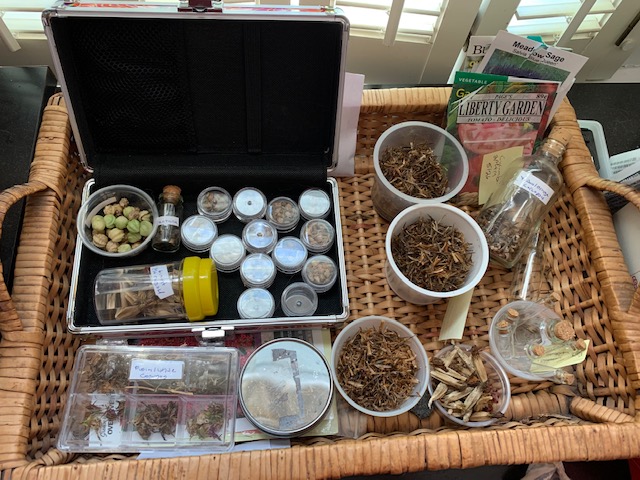
I've been busy harvesting seeds from my various mostly potted plants this year, which include mainly coreopsis, lantana, nasturtium, cosmos, calla lily, marigold and ragged robin. I am well stocked now for next spring. Not sure I'll have any space to plant stuff like the cosmos, but I have continued giving away a lot of seed.
I'm still waiting for all the bills for my surgery. So far I've paid just the anesthesiologist one, which frankly, was quite small in comparison to what I thought it would be: $312.
Flu Shots and Lunch Out
Today I got my flu shot. Next week I'll focus on getting dad his flu shot. We had a lovely lunch at one of our favorite country taverns, which was a nice drive with the foliage changing color. This was my dessert, a "triple chocolate mousse."

You never know where a conversation with my father wil take you. We discovered we both admired Vespa scooters, and before I knew it, dad was offering to buy himself or me one. Um, dad, you can't drive one.
Passport Arrives After 3-Month Wait!
I am very excited to have finally received my new passport in yesterday's mail. It had been so long since I applied for it (last July) that I had no idea what it was when I got the "official government business" envelope. I see a lot has changed in the design since my old one. Like, my old one's cover was kind of like a royal blue color; this one is a dark navy blue. I don't have specific travel plans, but I figure if I'm going to go anywhere, it likely will be in the next 10 years.
They have yet to return my original birth certificate, which they indicated would come in a separate mailing. Sure hope they don't lose it!
Making My Christmas List
My cousin, the one who was here during my surgery, announced he has decided to order me my Christmas present now, in case, there's a delay, and I can choose to open it upon receipt or wait. And that it was something he thought I "really needed," and that he would order it from William Sonoma.
Honestly, I think he likes to tease me with "hints." I have no idea what it is I so badly need, but he tends to be very good at picking out presents an he always buys the best. This is good, but a little initimidating when it comes to me choosing a gift for him. I'm always afraid that he's not going to like it. In the past, he's told me what he likes, but it's not much of a surprise that way.
I want to start my Christmas shopping EARLY to avoid delivery issues.
Posted in
Uncategorized
|
2 Comments »
October 10th, 2021 at 05:58 pm
On cloudy and overcast days, my energy level really takes a hit and I find it hard to get much accomplished.
Found Diamonds!
I got tired, finally, of the fact that my favorite flannel shirt was missing 2 buttons, so I went to my button and sewing supply box to see if I could find some buttons that more or less matched. Then I became distracted by all the shiny buttons and set about to organize them. At the very bottom of a small cardboard box that contained buttons, safety pins and little screws, I found 2 old diamond stud earrings! Don't ask me how they ended up in the box, but I hope to sell them to a local jewelery store and get a bit of cash. That would be fun!
Knee Surgery Recovery
I'm already 17 days into knee surgery recovery. I'm feeling stronger, but I'm a bit afraid to bend the knee too much (like when you walk up stairs) cus even though I can do it, a week ago it kind of felt like one of the sutures was pulling apart every time I bent the knee, and in fact one of the sutures did look a bit more open than the other one. So I went in to see surgeon this past Monday and he said to defer the start of physical therapy for a week to give it a bit more time to heal. I'm still doing hourly exercises each day, but none of them requires knee bends. They include leg lifts, ankle flexing and balancing on that leg for about a minute at a time.
I haven't gotten the bills yet for the surgery, but when I called ahead to find out how much it would cost me so I wouldn't freak out, they told me there would be 3 bills: 1 for the surgeon, 1 for the anesthesiologist and 1 for the facility (co-owned by the doctor, interestingly).
So far my costs are well under the roughly $4K I was told I'd need to pay as I haven't met my annual $4300 deductible. For some reason, 2 anesthesiologists each billed me $156, so I'd like to find out why. The doctor billed me $1,232 and so I'm just waiting for the facility fee.
Deer Kill in the Yard
Three coyotes killed a doe in my yard roughly a month ago now. At the time, I searched the property looking for something dead as the stench was awful. I didn't learn of the deer's location until I asked my lawn mower guy, who said "I thought you knew" where it was. Nothing but the skeleton is left already, with the head and some leg joints severed and separate from the body.
I saw 3 coyotes just a few days before I began to smell it, and at the time (early am) they did not appear to be "hunting" anything but seemed animated or excited by something as they ran back and forth from my back yard to the front, where the deer was, several times. Impressively, they covered a distance of over a hundred feet in just a few seconds.
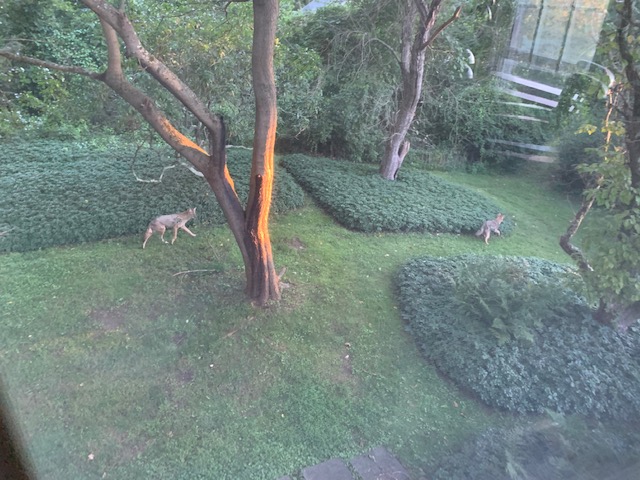
Above are 2 of the 3 coyotes, headed down that little path in upper right of photo, which leads to the back side of a very large white pine where the deer was killed.
This is what they left. (Note the skull and some leg parts have been severed and can be seen above where the body is.)
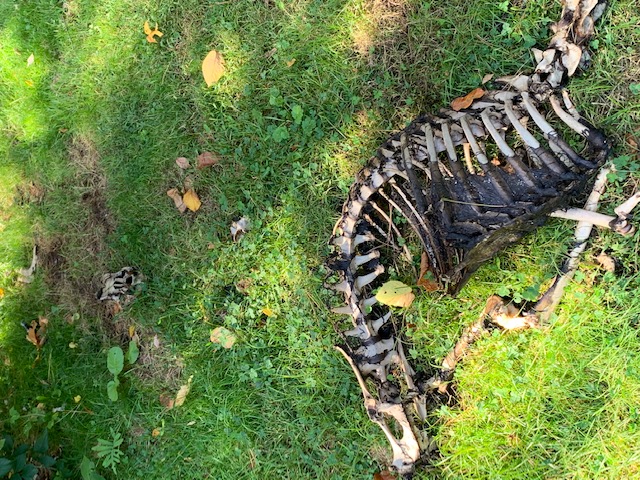
Anyway, now I feel I should get rid of what's left before my mower returns on Tuesday so he can do a complete mow. I plan to use a shovel to fling the bones into the nearby brush so it's all at least off the lawn and mostly out of site. I am not looking forward to this task and it kind of grosses me out, but somebody's gotta do it....
Just yesterday morning I spotted a red fox trotting past the house from the kitchen window, headed in the general direction of the deer bones. Indeed, I can look out my upstairs office window now and see a leg joint there, presumably carried there by the fox or other scavenger. Although I have seen tracks in the snow, I haven't seen a red fox here in years, so I'm sure it was attracted by what the coyotes left behind.
Got a Raise
I asked for, and received, a 5% raise at my p/t job 2 weeks ago. Not much of a biggie. They have yet to get the paycheck right.
How I Spent my Tax Refund
I did end up spending the unexpected tax refund (thank you Mr President), not from my return, on a new ultra-high-efficiency Samsung washer/dryer. I love energy-efficient gadgets and appliances in general; the dryer uses heat pump technology and actually removes moisture much the way a dehumidifer would. Kinda interesting, but I'm not sure I'm lovin' the front load vs top load. If you don't have a low laundry basket to put under the open door, clothes tend to fall out when you're filling or removing items. It's awkward and hard on the back. Most of these types of washers/dryers have a stand that at least raises them a foot or so higher, but Samsung apparently doesn't make them for this model. I may have to look into retrofitting something to make it better. The dryer plays a song when the load is dried.
Posted in
Uncategorized
|
4 Comments »
August 7th, 2021 at 10:12 pm
Well, Dido beat me to the punch with her account of our recent get-together at a small country town in the Poconos of Pennyslvania. Although it was just a day trip, I REALLY enjoyed getting out of town for a while; it was my first extended trip since the pandemic started, and even just driving west on the wide open highway in unfamiliar territory felt so good.
I think she covered all the highlights: bike ride, yummy lunch and browsing an antique mart, all of which allowed me to minimize walking due to my knee injury.
I've come to the conclusion I'm going to need surgery to fix it but still have a lot of trepidation about it. I saw a surgeon over a year ago now but I'd wanted to try physical therapy first. It helped, but only to a point. I really can't walk any great lengths, or it will start feeling sore and before you know it, I'm favoring the knee, then limping it I keep walking. I can get around well enough around the house or runnng shopping errands, but extended walking, no. I feel it's already affected my quality of life and I've given the knee ample time (over a year) to heal on its own, but it hasn't, really.
So Monday I plan to schedule a return visit with the surgeon, who will probably want to repeat the x-ray since it's been over a year and I've been walking on the knee. I'm not sure how quickly they can schedule the surgery, but I'm thinking October/November would be a good time, since it's before any major bad winter snow and I'll also be done with any kind of yard work and spending more time indoors anyway.
My cousin who lives 4 hours a way has generously offered to come take me to the hospital and back, and stay as long as I need him to. He's retired, so he has the time. I am so grateful because the many details of how the recovery would take place were kind of overwhelming and had been keeping me from doing anything about it. I may need transportation to physical therapy or follow-up appointments afterwards, and I'm not sure if I'd be allowed to drive. I do have some stairs outside leading to the house. I may be on crutches, so I'd want someone besides an Uber driver to help me up the stairs and make sure I'm settled in okay.
I would plan to let him sleep in my bed and I would live on my first floor for a while, move my computer/router to the dining room table, and I guess I'd have to buy a bed or something for the downstairs. Wondering if I could make do with just a cot or futon. I don't have any extra space for it afterwards, unless it folds up or something. The main thing I think would help is if it was off the floor to make it easier with the knee getting up and so on.
I'm not looking forward to it but have talked to various others who've had similar surgery and it didn't seem to be a big deal. It is a big deal for me, partly because I live alone and don't have a spouse I could assume would be there for me. Hence the added apprehension.
In other news...
A friend of mine is not only baking me a cake of my choice (dark chocolate/peanut butter) for my birthday, which was this past week, but making dinner too! I'm not positive I've ever had linguine and clam sauce, but I think I'll like it. I'll bring her a zucchini from my garden. I was a bit relieved to hear she finally got her 2nd shot, something she had long delayed for months after having a very adverse reaction to the 1st shot. Especially now that I'll be having dinner in her home.
The garden is doing pretty well. My jumbo sized cherry tomatoes are finally turning red and I've had a few already. I think I've picked 19 zucchinis so far (yes, I keep track) and my string beans, which are under row cover, are looking fabulously healthy but are only now forming flowers. (I planted them mid-summer.) I had a smallish eggplant and have a few more on the plants. I have an asparagus bean plant that I don't expect to amount to much. It's growing but is completely vulnerable to deer browsing since it's growing on the fence that surrounds my raised beds.
I'll be spending a few grand for a tree company to trim some dead wood off a giant silver maple in my back yard and cable the 4 co-dominant branches, which are huge and heavy. Not only does the cabling provide extra support, but if any branch did fall, it would fall close to the tree, not on my house. It's actually more money than I've spent to day on any tree takedowns in the 25 years I've lived here
, but it's been on my radar for a while. I feel distracted by my knee issues and other stuff, so I don't think I'm going to get a 2nd estimate from someone else. I just kind of want it taken care of.
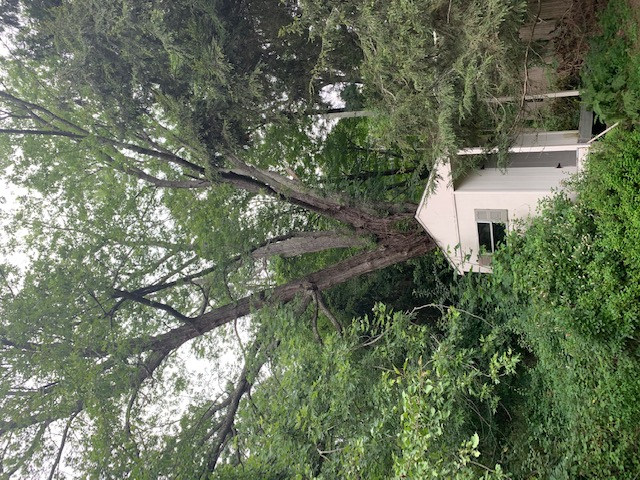
That's my tool shed in front of the tree, which my dad built the year I bought the house.
Posted in
Uncategorized
|
4 Comments »
July 11th, 2021 at 12:08 pm
I was sorting through some old receipts and I came across the receipt for the garage door opener I finally had to replace earlier this year. It was a Sears Roebuck model that came with the house, so I knew it was old, but the receipt confirmed a previous owner had installed it...in 1988! That garage door opener lasted 33 years!!!
Looking at that old receipt got me interested again in tracing the history of my house. I did it once many years ago, but got stuck at one point in the 1940s, I think, and in any event, I can't find the list I made of all the prior owners I did research back to that point. I will try to set aside some time to start the process at the town clerk's offce where they keep the records. The house was said to be "circa 1930" when I bought it, so I'd like to see for myself how far back I can go, or if there are records prior to that time.
I bought a cordless, battery-powered hedge trimmer and tried it out last night. I love it! I've had a B&D corded electric hedge trimmer for years, but even with my 100-foot-long power cord, I only used the trimmer on some boxwoods near my driveway. Now, with the cordless trimmer, I was able to walk the entire perimeter of the property, easily cutting through the any brambles and other overgrowth that surround me. Of course, I'll need to go back and pick up all the trimmings, but at least I can keep stuff trimmed better so my mower man doesn't just avoid doing all the edges.
As my knee continues to heal, I have reduced the frequency of my physical therapy/doc visits because it's been getting kind of costly, plus I want to preserve some PT visits should I end up having to go for surgery anyway. My insurer said they'll cover me (I still pay a $30 copay) for up to 40 visits for any one issue in a single calendar year. I think I've used up 7 PT sessions so far.
I also thought that bike riding could be a good way to continue rehabbing the knee without the pounding of the joint that comes with walking on a hard surface like asphalt. I've tried it out a few times in a very limited fashion around my neighborhood, and liked it. Unfortunately, my neighborhood is surrounded on 2 sides by busy roads and another way to go involves a very steep hill. I have to be careful coming to a stop and not hopping on that leg when I dismount, but the circular motion of pedaling should be good to help stretch the tendons in that leg in a controlled fashion, and they are very tight.
Here in the Northeast, we've been stuck in this tropical weather pattern of heavy rain followed by continued mugginess and high temps. Not the kind of weather that inspires me to do any much-needed weeding or cutting back of vines. My tomato plants have toppled over from their own weight and really need to be tied up today. I've been steadily eating zucchini and my mid-summer-planted stringbeans are just popping up. I'll be growing them under row cover to keep beetles from attacking them; one hoop/netting thing is done, and now I just have to cut row cover for the other one. I just use 2 plastic hoops, over which I put the netting, which is secured by small rocks.
Tomatoes, unfortunately, are much to big to grow under a row cover! Same for the zucchini and eggplant. I only planned to have ONE zucchini and 2 cucumber plants, but somehow I planted TWO zucchini, which have now taken over.

Last week I was able to switch my auto/home/umbrella insurance policies over from Safeco (division of Liberty Mutual) to Progressive, saving myself $368!! Safeco quoted me a pretty good rate of auto/home about 5 years ago, but every year since then, they hike their rates by about 15%, and I've never in my life filed any claims. This really irks me. I feel they take advantage of good customers instead of rewarding them. This seems to be the modus operandi for many insurers these days.
My car insurance was about the same as Safeco, but the real savings with Progressive came with the homeowner's insurance and the umbrella (aka "excess liability") policies. As part of the discount, I will be doing their Snapshot program where you download an app on your phone that allows them to monitor your driving. So for 3 months, starting at the end of next month, when the policy becomes effective, l'll be following the speed limit, and braking and accelerating very gradually. And I will retake the AAA safe driving course.
On a bit of a whim (!) I decided to apply for a new passport, and was at the PO a few days ago to do so. I say "whim," because I have no specific plans to travel abroad, but I figured if I do travel, it will most likely be in the next 10 years. Also, a passport could serve as an important form of ID if, by 2023, you don't have one of those special driver's licenses with the star in the upper right corner, and I had just gone and renewed my driver's license recently without "bothering" with the extra paperwork involved in getting that star before realizing I really should have. If you don't have it by 2023, you'll need to show your passport even to fly domestically. All thanks to 9/11. All these new requirements just weren't on my radar, for some reason.
The only thing that made me nervous is they require you to hand over your original birth cetificate, which is mailed with your application and then returned in a few weeks. Makes me very nervous. The total cost was $160.
I was sad to surrender my old passport from 30 years ago, when I received a cool visa from Hungary and other European destinations.
Got together with a friend at one of the newer breweries in town. They rehabbeden th old buildings that made up the campus of a former state mental health facility. I love what they've done!

Recent lunch at a Polish restaurant with dad: stuffed cabbage and an enormous potato pancake..

At another restaurant recently, they etched the shape of a horse (their emblem and namesake) into the dusting of cocoa powder in my dessert!

Posted in
Uncategorized
|
4 Comments »
July 8th, 2021 at 09:40 pm
Please join me in congratulating one of our own resident experts here. Dido at Fiscal Fitness here has passed the Certified Financial Planner exam today!
You've studied long and hard...you earned it, girl!
Posted in
Uncategorized
|
16 Comments »
May 14th, 2021 at 12:59 am
Disclaimer: This has absolutely nothing to do with saving money. It has more to do with my social life, which has gone from zero to 70 in a very short amount of time.
Who would have thought that on the cusp of true "seniorhood," Wild Blue Yonder would be dating. Yes, I have dipped my toe in the online dating waters after a very long hiatus. I gave up on dating a long time ago, and then when my mother became sick, I dropped everything to take care of her as best I could. After that, I started looking after my father, and that, too, takes up a fair amount of my time, but it is something I feel very strongly about doing.
Bachelor #1 is retired but keeps busy playing landlord/handyman for several rental buildings he owns. He's a little older than I would like, which would be 9 years older than me. Maybe it doesn't matter much in your 30s, but it could at my age. He is very trim and looks good for his age. He has been active politically in the city where he lives, ran and lost in a state senate race because he's a moderate Republican/libertarian in a solidly Democratic city. He showed me a letter he just wrote resigining from some Republican committee he served on because he dislikes the lockstep way the party is remaining loyal to Trump and promoting the election fraud thing.
I also don't like that he lives about 50 minutes away from me. I find myself wanting to stick closer to home these days, and traveling to be with someone takes a lot of time out of your day. Of course, I'm not traveling to work anymore, so this should not be a big deal.
His personal life is a little complicated. His ex-wife died a few years ago (long after they had divorced) and made him promise to take care of her 2 daughters (not his), who are now teens. He had told me earlier that he wanted to take things slow, but he asked me if we could get together again this Sunday. (I have other plans.) He is hoping I invite him over to my place for dinner. I told him I am vegan and he won't like my cooking. He said he is fine with mac 'n cheese.
Bachelor #2 is closer to my own age and an architect who does commercial work. He's about a 30-minute drive away, and shares some interests with me including nature/outdoors/wildlife/kayaking/gardening and he's a liberal, like me. He's been married twice.
I had stronger feelings for Bachelor #2 from the start and after having met both of them for the first time last week, for coffee, I was planning on parting ways with Bachelor #1, but we met for lunch today and I'm beginning to feel more interested in him. He seems very agreeable and easy to get along with.
I see Bachelor #2 for dinner Saturday night here in town, and he's coming to my place to pick me up.
I really dislike dating 2 people at the same time. I can't remember what I tell each of them and probably end up repeating myself, plus I feel it's somewhat deceptive, although I know people do this. I think my problem in the past was that I tended to rule men out too quickly without really giving them a chance beyond one or two dates, so I'm trying to give it more time.
Posted in
Uncategorized
|
7 Comments »
April 15th, 2021 at 07:16 pm
I know I'm not here as often as I used to be, but it is very nice to have a familiar place to return at those rare moments I have "spare time." Today, I have spare time because it's one of those dreary, rainy, overcast days.
But even today there's a silver lining: the dreariness and lack of sun outside really makes my cherry tree blossoms pop. Their bloom is spent very quickly, but right now, they look lovely. Although the three cherry trees I planted I later cut down years ago (yes, I chopped down a cherry tree, like GW), they are easily planted by birds eating the small cherries, so I noticed this year I have at least 5 small and mid-sized cherry trees abloom in the woods.

I see my gladiolus are alreay coming up, 3rd or 4th year in a row...and they're supposed to be an annual bulb! I have a very large new bed I'm creating within view of my patio where I pulled, cut and dug out a large stand of sparsley blooming forsythia that looks a mess the rest of the year and is constantly attempting to gain new territory.
This, after I had been telling myself I would try to simplify my yardwork as much as possible in coming years. But the desire to plant and attract bees and butterflies is just too great.
Some of the space is close to or under the canopy of a giant Norway spruce, while the other space is more sunny. So far, I have purchased:
1. A river birch, a beautiful tree I have wanted for years. And it cost me just $10, through a high school fundraiser. It's likely to be very small. I pick it up later this month.
2. A bluebeard perennial, purchased through the conservation district; I pick it up later this month as well.
I'm fairly confident I can obtain other perennials for free through my Buy Nothing and gardening facebook groups through the spring. If not, I can also divide some existing plants, though it would be nice to increase the diversity of what I already have here. They just need to be deer-resistant. I'm sure I will also be tempted to browse the offerings at local nursery, although that would be the pricey route.
There should be a break in the rain in about an hour, which is when I'll go out and throw a tarp over my peas in the raised beds, several inches tall already, along with a bunch of potted annuals/bulbs I'll put in the garage. Temps are supposed to remain above freezing, but just by a few degrees, and I'd rather not take a chance.
I went up to see my neighbor's garden yesterday. He has about a dozen half-finished projects and seems to lose interest in each before they're done! However, he does have a very nice small pond with waterfall and large bullfrogs and fish in it, along with a pen attached to huge barn for his sheep and cow and lots of quirky vintage garden ornaments he collects here or there. When we both have our 2nd shots, I will join him on a few trips.
He had planted a large orchard of fruit trees, but his cow got loose one night and ate every single one. He does have quite a few raised beds, many of which are planted with elderberry, from which he makes a great wine using the flowers, not the berries.
He also built himself a great greenhouse and pavillion-type structure with a floor made of round stones in the form of a dragonfly. He's built patios and small gardens with raised beds for several of his tenants who will likely never leave because they are more friends than landlord/tenant. He and his wife nursed one of his tenants, a single woman with no close family around, back to health when she got covid.
I finally got around to seeing an endocrinologist for my osteopenia. She said I was doing everything right in terms of diet/exercise and so it was really a simple consultation/assurance there's nothing else I could be doing. Of course, it doesn't help that my knee injury/menescus tear still hasn't healed after over a year.
I had the excuse of the pandemic for not really doing anything about it after seeing an orthopedic surgeon who wanted to operate. The physical therapy I had for 6 weeks over the summer helped, but just to a point. There was a point when I thought it was mostly healed, so I decided to resume some more knee-strenuous exercises for bone health that I'd been holding off on, like jumping jacks. Big mistake. Knee not ready for that, and honestly, it's not much better today than 8 months ago.
I still don't want surgery. Not to mention, don't even know how I'd get to and back from the hospital, or how I'd manage on crutches for several weeks here, live on the first floor, get to follow-up appointents if I couldn't drive myself and so on. It all just seems like too much. I would like to see another doctor about it (not a surgeon) to get more guidance on what to do or if it's even realistic to believe it could still heal on its own. But it seems like every orthopedic doctor around here is a surgon. That's what I'd read when doing reseach: that the vast majority of menescus tears can heal on their own. And I have reason to believe my 2 tears were not so severe, because my knee, for instance, is not "locking" in place.
Posted in
Uncategorized
|
4 Comments »
April 12th, 2021 at 01:50 pm
I worked a full week last week to cover for the person who shares my job. I won't be paid any extra for doing so. Why am I okay with this?
It was part of the agreement I made with my manager at the start of the pandemic, after I began working from home. The deal was that I'd be paid a fixed weekly amount regardless of how many hours I worked. Billable hours don't include the time I wait for work and am essentially on call roughly 8 hours a day, 3 days a week.
The fixed weekly paycheck is roughly based on an 18-hour work week but I have never worked an 18-hour week since working from home. I just checked my weekly average hours for 2021 to date and it's just 9.67 hours, so if you don't factor in time spent waiting for work (I do plenty of other things during this time), my hourly rate of pay is actually more than 50% higher than what it is on paper.
Put another way, my typical work week includes 10 hours of work and another 14 hours sitting around waiting for work. It's not that my employer is inefficient or disorganized; it's just the nature of my work and how the agency works that makes the work flow a little bumpy and uneven.
This is a contract job, so no benefits. Just a pretty sweet paycheck for which I am very grateful.
I'm looking forward to getting my 2nd vaccine shot a week from today. I am really looking forward to spending more time with friends I've been keeping at a distance, and, silly as it sounds, shopping at some of my favorite stores again in person. I've enriched Stop & Shop long enough. Aldi's and Trader Joe's, I miss you.
I already hit the $1,000 spending requirement in month 2 of my new US Bank Signature card, which will mean I'll get an easy $200. I'd prefer the cash, but would take it in gift cards if I have to.
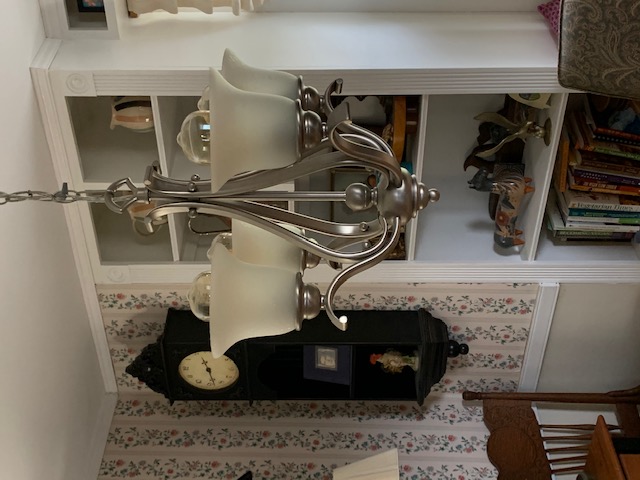
I'm eager to get going on various home improvements this spring, as soon as I'm 2 weeks post-vaccines. My electrician is ready to come swap out my DR chandeleir, installing a "new" one I got from Buy Nothing and putting the small one that's there now in my office, in place of the ceiling fan, which is still something I use, but with the central air, it's less necessary, and I have other fans to use if needed.
I hope I won't regret doing that, but I still really like the current chandeleir and thought it would look cool in my office. I have fairly low ceilings, so he just needs to hang it so it's pretty flush with the ceiling so no one knocks their head into it.
So here's the exsting chandeleir. It's a bit small for a dining room.
And here is the new chandeleir:
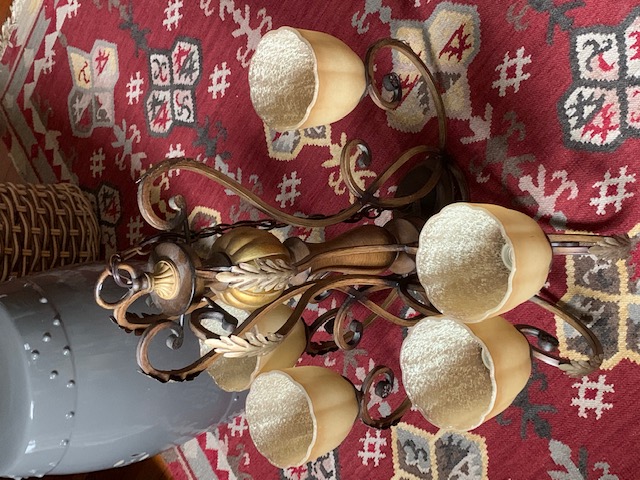
The funny thing about this one is that it looks like it should have a 6th shade, but does not, so to me it looks a little assymetrical, which I guess is intentional.
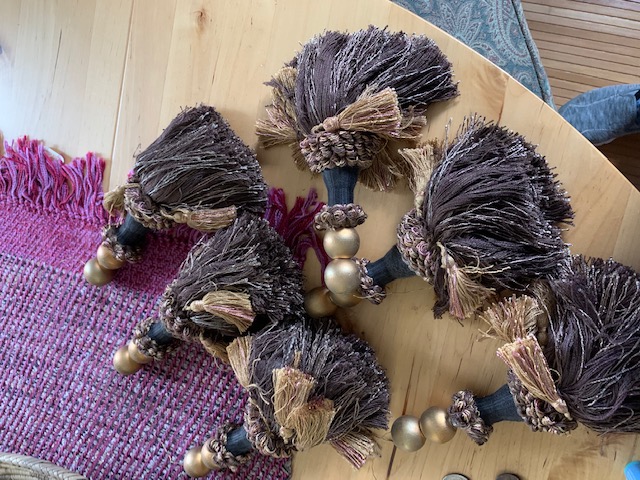
This was actuallly the second chandeleir I was gifted from Buy Nothing. After getting the first one, I was afraid it was so huge it would overpower my small dining room, so I thought the second one would work better and I regifted the first one. I did, however, keep the cute little tassels that came from the first chandeleir to use with the second one.
The less interesting part of the electrician's visit would be to update some wiring by the circuit breakers, whch would protect all the wiring in my house if it were ever hit by lightening. This is something he advised I do probably 4 years ago.
My mason will also hopefully be stopping by this week. I want him to redo the concrete wall on the exterior of the north side of my house and also replace a small basement window on the south side. This is an old house and a lot of the basement concrete is crumbling. They redid one wall inside basement last year and did a GREAT job.
There are 3 or 4 other jobs I want to do but likely won't do all this year. All were on my lists in previous years:
1. Get a pergola so I can actually enjoy my patio more in heat of the summer. My nervousness and uncertainty about getting something installed that won't blow away in a hurricane is what has caused me to delay.
2. Replace hot water heater. It works fine, but it's at that age that's considered "average" life span.
3. Replace collapsing, rotting stockade fence that keeps me from having to see neighbors' renters zooming up and down his driveway, which goes past my back yard. I'm afraid this is going to be super expensive as it's a length of probably 100 or more feet. I'd probably stick with what I think is cedar fencing, as it lasted about 15 years, I think.
4. Replace upstairs bath vanity. It's totally needed. I have double sinks now and only want one sink in replacement vanity so I have extra counter space for all my plants. Eventually, I want to replace the current tub with a walk-in shower.
Posted in
Uncategorized
|
2 Comments »
January 16th, 2021 at 11:38 pm
I didn't intentionally set out to make organizing my living space such a priority for the month of January, but that's what I've been doing, and let me tell you, just the little bit I've done feels great...and greatly productive!
It began with my Hoover carpet steam cleaner. The last time I used it was over at my mother's condo. I did all her carpeting until toward the end, it seemed to not be working. I finished up, dragged it home, and stuck it in my hall closet, where it sat for OVER 5 YEARS.
I'd been wondering if it still wouldn't work if I used it, and if it didn't, I was going to gift it to someone on my Buy Nothing group, to someone willing to tinker with it. I only remember using it a handful of times.
But just the thought of having to read thte tiny mouse print instructions was a huge turnoff, but I would have to as i didn't remember exactly how to use it. I put this project on my To Do list but for weeks this particular item wasn't touched.
Inexplicably, last week, I just pulled it out and went at it. I cleaned out a filter and soon I was steam cleaning all my area rugs! Seems to work fine! The reason I thought it wasn't working is because I had noticed that while i put quite a bit of water down into the rugs, relatively little (dirty) water was sucked back up. I think that's normal now. Anyway, huge sense of accomplishment after having done that, and I'd love to get into the routine of cleaning my carpets once every 3 months. How often do you do yours?
Next, I turned to organizing in my office, which doubles as my workout room. It always seemed like such a mess in here with my yoga mat, hand weights and a huge exercise ball. always in the way. I decided I no longer need the exercise ball for my knee, so I brought that to the attic, and I reorganized my computer desk space so that i could more neatly group all my hand weights (3 sets) in another space that is, importantly, not on the floor. Not good for my back to always have to pick them up off the floor. Now I don't have to. I tidied up my computer desk and a credenza-type set of shelves, and things seem so much more orderly and attractively arranged now. I'm really taking pains to keep it that way.
I recently ordered another bamboo set of shelves, which arrived today, so I spent some time this afternoon putting it together. It was relatively easy to do, a relief. The shelves fit perfectly in my downstairs hall closet, which is off my kitchen and a somewhat under-utilized space. So now when I buy things in bulk, which often happens, the overflow can go ont these shelves and I can find things more easily in my kitchen pantry. It feels go good to be organized!
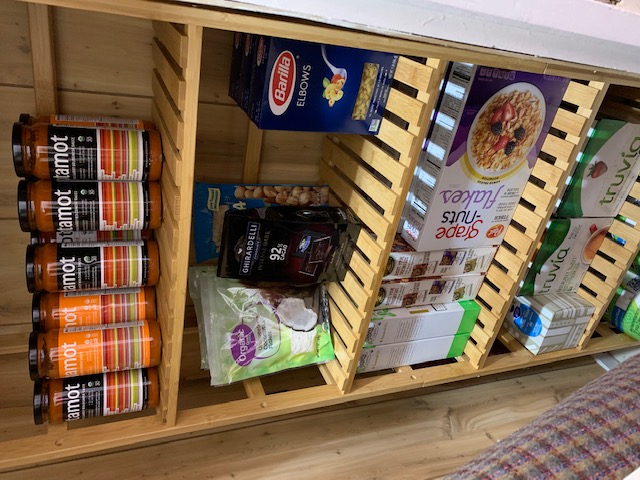
There is still more to do, and progress will continue!
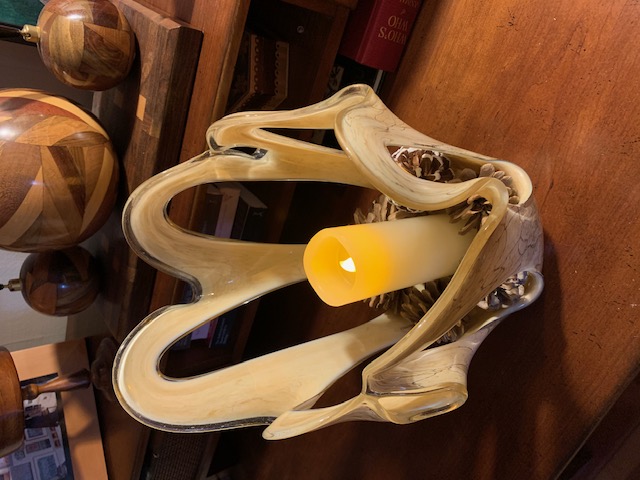
I recently bought a set of flameless candles, and I absolutely love them! They are battery-operated, and since you can set them on flicker mode with a small remote, you can instantly create "ambience" and a peaceful, hygge-inducing sense of well-being. I have them everywhere. I used one in the interesting art glass vase from Buy Nothing (2nd photo down), along with some pinecones.
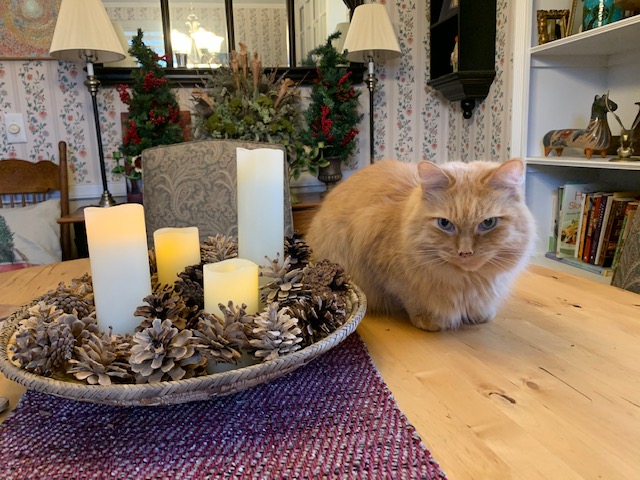
I also recenlty acquired this set of 4 brocade slipper chairs for my dining room table, replacing the hard wood chairs I've made do with for 25 years.
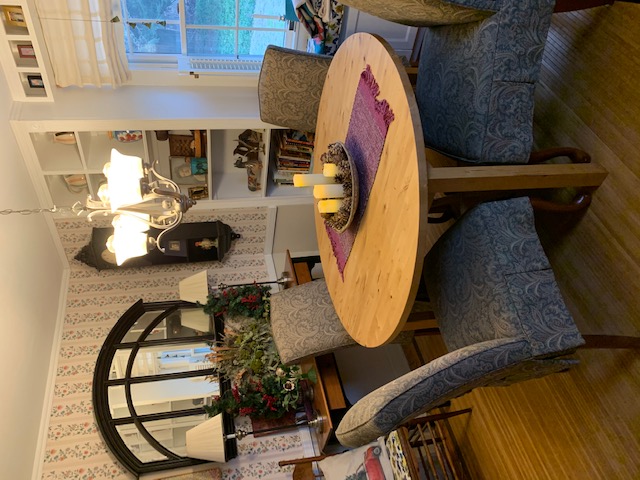
My father has complained about how uncomfortable the wood chairs were, so I can't wait to have him over again with the new set. The legs are fairly scratched up, but I plan to try those markers you can use to make scratches blend into the wood stain. Tomorrow, I'll be picking up a large round, ornate medallion-type mold, the kind that surrounds a chandelier on the ceiling. I thought it could be the finishing touch over my dining room set.
In return, I've given away a duplicate set of hand weights I had (hot item), a wall clock I realized I didn't need, a set of 9 wood cooking spoons/spatulas I never use and those 4 old wood chairs were snapped up by a young family who needed something sturdy and easy to clean. They should be picked up tomorrow.
I had an early dinner tonight and have started my weekly 24-hour fast.
Most of the Christmas decorations (which no one but myself was able to enjoy) have been put away. A few more things I hope to do tomorrow.
I made my $7,000 traditional IRA contribution for 2020, and hope to do a much smaller SEP-IRA contribution tomorrow; had to wait for T. Rowe Price to set up ACH transfers for a different bank I'm now using.
I'm getting back into the routine of nearly daily walks weather permitting. It was 8 long months for my knee to heal, but now I can walk longer distances without pain, so it was all worth it. I'm thrilled, to say the least. and I'm continuing my strength/balance exercises at home 3x a week.
I feel that all this time at home has helped me establish new routines and a structured week that regularly includes work, home workouts and walking. I cook all my meals from scratch, no processed foods.
My neighbor's ewe had triplets, and this one was born with a broken leg. He was able to splint it himself, and now the lamb lives in the Big House with them and his tenant is bottle feeding it. Lamb's name is Tripod! How appropriate. Unable to load pic right now.
Posted in
Uncategorized
|
5 Comments »
January 1st, 2021 at 01:28 am
It's that time of year when Patient Saver tallies up all the spending she's done throughout the year to see where she stands.
Here, then, are my ranked expenses with commentary:
Property taxes, $6,792. No surprise here. My property taxes have always been my #1 expense. This won't change til I turn 65 and can take advantage of discounted senior property taxes which will make a big difference.
Garage stone veneer, $5,900. This was the most expensive home improvement I did this year, but even though it was strictly cosmetic, I have no regrets. I love the look of the stone, and the stone veneer and paver driveway now have the look of a side courtyard.
Food, $4,754. This represent a small, 4.5% decrease from 2019, so it's a small victory in a multi-year battle to contain my food expenses.
Health Insurance, $3,524. This was actually 18% less than what I spent in 2019, when my monthly premiums were higher.
New Water Tank, $1,276: My old water tank, which strictly services my 2 outdoor water faucets, began to leak unexpectedly late this year, so I had no choice but to replace it.
Cat, $1,171. I felt like I was bringing Luther to the vet a lot, for various reasons, but his problems were nothing too serious, which kept the bills down. This was actually 18% less than 2019.
Stairway Railing, $1,100. Pretty pricey. I wanted to get the railing years ago, so I'm glad I got it.
Heating Oil/Cleanings, $1,087. So while my top 5 expenses, not including the one-time home improvements, were all down compared to 2019, this expense was higher than in 2019, by 25%! It's somewhat surprising since oil prices on a per-gallon basis are way down, due to the pandemic, but since I've been working from home most of the year, I keep the heat at 67 all day long.
Electricity, $970. This is about what I spent last year. I go to some effort to shop around for electricity whenever I can achieve some savings, but evidently it doesn't really make much difference.
Lawn & Garden, $970. This cost was down by 23%, which surprised me since I wound up having to pay someone to mow my lawn for most of the season after injuring my knee. I do plan to do my own mowing in 2020 to save money and get good exercise. (I have more time than ever to do this as I don't expect to be returning to the office, even when the pandemic is over. I think the co-owners of the company have discovered they really CAN rely on their loyal staff to get the job doneeven working remotely, and so they're doing fabulously since they're not paying for office lease, phone/Internet, electrictity, etc.)
New Computer, $912. I bought an "all-in-one" computer that doesn't have the tower or a lot of wires. I like it.
Out of Pocket Medical/Dental, $910. This is a 35% increase over last year. I didn't get all my usual checkups due to COVID, but I did have some unexpected issues with my menescus tear, floaters in my eye that had to be repeatedly checked, along with a physical, lab work for that, eyeglasses purchased very cheaply at Zenni's, and a DEXA scan which told me I have osteopenia. (The reason why I plan to mow next year.)
Car Upkeep, $824. This is down 16% from last year, a pleasant surprise for a 7-year-old car, but I still have well under 100,000 miles on it.
Raised beds, $747. My neighbor built them for me at no cost as part of a barter deal, but I did have to pay for materials, and I opted for the more expensive cedar wood, plus the fencing. I got plenty of great produce from the garden, inlcuding my last butternut squash which I just cooked up a few days ago, oodles of tomatoes, eggplant, kale, etc.
Homeowners Insurance, $691. It didn't rise too much from last year.
Entertainment, $652, a bit more than last year. The bulk of this is due to several subscriptions, including Ancestry.com, Newspapers.com, cronometer.com, a bus trip to Hudson Yards in NYC that was cancelled due to COVID and rescheduled, along with some free weights since I couldn't go to the gym and of course my monthly Hulu.
Car Insurance: $619, no big changes there.
My remaining expenses don't add up to a whole lot. Of note, I spent just $487 on gas for the car, a 45% drop from 2019 since I'm not commuting. This past month, I really felt I was getting a little out of control on clothing spending, but it turns out I spent about the same as in 2019, at just $376. I bought a lot of comfy fleece pullovers.
In total, my expenses came to $41,276, which is in keeping with the past 5 or 6 years at least. I never feel deprived, and I never try to "budget," other than to have a general idea of how much I should be spending on stuff. I'm pleased that my top 5 expenses all either stayed the same as last year or dropped. And I eked out a small decrease in my food spending.
And, just like last year, aside from home improvements, my Top 3 Expenses were: Property taxes, Food and Health Insurance, in that order.
On the subject of Home Improvements and looking ahead to 2021, I would love to replace the decrepit cabinet in my upstairs bathroom. And replace my small refrigerator which periodically malfunctions with something bigger, which would require some carpentry work. Don't know if that will happen due to COVID manufacturing slowdowns, but these are the only 2 home improvements I'm really keen on at the moment.
I wish all my friends at Savings Advice and safe and healthy New Year. Tonight will be a quiet New Year's. I enjoyed a glass of Reisling just now, and next plan to rewatch the trilogy of Lord of the Rings, which I discovered is on Hulu. I don't think i ever saw the 3rd movie, so will be a treat.
Posted in
Uncategorized
|
2 Comments »
December 16th, 2020 at 08:54 pm
After many years of not putting up a full size-tree (partly due to it being just me, plus my cat may get overly curious), I decided to spring for a 5-foot artificial tree. I joined a Facebook group made up of people who collect vintage Christmas ornaments/decor a few weeks ago, and it's easy to get seduced by all the glam this time of year.
But I didn't want a plastic tree, and that's 90% of what's available if you're looking for artificial. I settled on a wrought iron tree that, since it's devoid of actual green branches, really shows off the ornaments themselves. I have a fair number of old ones collected over the years from my grandparents and other family, and I also have some precious handmade ones from my sister, mother and grandmother. They sat in boxes in my attic for years when I chose to make do with small, tabletop trees.

I've been living like a monk since late March, just so that when I get together with my dad, once a week, that I can rest easy knowing I'm not exposing him to any virus germs. I was going to only BJs, once every 2 weeks, for months, solely becuse they had early senior hours and very wide aisles, but more recently, I've discovered how wonderful it can be to avail myself of Stop & Shop's curbside pickup. I can't understand why they're willing to charge so little ($2.95) for this service; one of their workers still has to spend at least 20 minutes running around collecting all your groceries (which you order online) and then bring it out to you in your car. I absolutely love it and think it's worth every penny, and it means zero exposure for me, which is something I tend to get anxious about.
Still, when the pandemic has subsided, I doubt I will stick with Stop & Shop, since they are noticeably more expensive than Aldi's, BJs and Trader Joe's. But I could see where their service, if they continue it, could really be a godsend if I should ever have surgery, or even if i had a bad cold and didn't feel like walking through a supermarket. So far, they've been 100% accurate in filling my orders.
I'm still working at home, and word is that in my small company, the husband/wife owners have already sold their home and moved to an island where they regularly vacation. She is a very recent cancer survivor, and I think the pandemic may have pushed them to possibly fast-forward that part of their retirement plan.
So what this means for me is that I could be working remotely until my own retirement in 4 years. This would be wonderful. How I longed for this during much of my career! No more 40-minute drives, nice as they were (but not at night), and no more putting up with the total lack of acknowledgement that I can do a better job editing with some peace and quiet.
Plus, I have worked out a pretty sweet deal with my pay structure so now I earn a fixed weekly amount and have much better stability of income that I can plan around. Most weeks I earn the equivalent of about $65/hr although my official rate of pay is half that. Of course, I am tied to my home as I'm essentially on call, but there's much I can do of a personal nature while I'm waiting for the next assignment. These days I'm working about 10-14 hours a week but am "on the clock" for 3 full work days.
Yesterday I made my $7K traditional IRA contribution for 2020, and am still thinking about making a SEP-IRA contribution since with the change in my pay structure, I'm now self-employed. I may skip doing any backdoor Roth IRA conversons since that will increase my gross income and right now I'm happy to be smack dab in the 12% federal tax bracket as I just work part-time.
Christmas, like Thanksgiving, will be super quiet. I would like to plan a nice meal with a bottle of wine for just 3: me, myself and I. I will call a handful of friends and family, and hand-deliver some gifts for a local friend who lives nearby. Trying hard not to get depressed. If the weather's decent, I'll go for a walk.
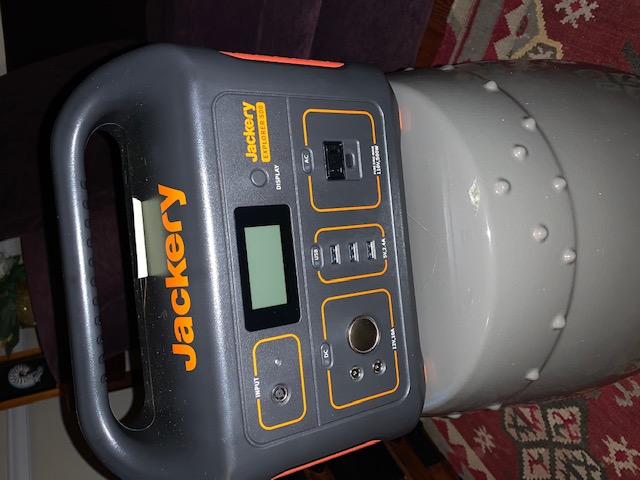
Today the Northeast is gearing up for a pretty major snowstorm; we're expecting around a foot. I am somewhat better prepared for an extended outage, although that is not being forecast as the snow is expected to be light, not heavy. I have several phone power banks now and also sprung for a jackery 500 lithium battery bank with a bunch of plugs on it. Although it won't power a full-size fridge or microwave, it would let me stay in touch with the outside world during an outage with TV and charged phones, plus a few lights. Scattered around the house I also have 5 light bulbs with built-in batteries; they'll work for about 4 hours with no power, so you could conserve all but 1 til it runs out, then move on to the next, so you have something more than flashlight at night. I love little gadgets like that.
I did also recently purchase a "smart" scal to replace my rusting old one. The new scale syncs with its app on your smart phone and records your daily weight, BMI, bone density and more, then tracks it over time. Apparently, my old scale was off by 2 lbs.
Posted in
Uncategorized
|
7 Comments »
October 30th, 2020 at 03:37 pm
I've been away for a while and see there's been some issues with posts...hope that has been resolved! I really like the much wider field when you're typing your post here.
I'm having a rare moment and feeling bored. Heavy rain changed my plans yesterday (the one time each week I interact with a live human being) and today it's snowing! Enjoying a cup of tea just now.
I was able to check a certain website online and see that my early absentee vote was indeed processed. Gave me some peace of mind, given the state of things.
Luther made a 2nd trip to the vet in just the past month due to the constant scratching of his ears and an unusual discharge from his eyes; he got his meds and is doing much better now, but twice-a-day drops in both ears and eyes is a bit much for him.
Not a whole lot to report....my days all meld into each others. I work Monday, Tuesday and Wednesday from home, and I purposefully socially isolate all week long so I can have peace of mind when visiting with my dad every week. He's homebound, so he can't give the virus to me unless he got it from my sister (low risk) or my brother in NJ, who periodically visits. This I worry about a bit more as he lives with his family of 3 others, including 2 kids who go to school and I'm not sure how careful he really is.
Besides seeing dad, my only routine outings are to get gas and groceries every 2 weeks. Sometimes I venture out to work in the yard, walk or do pickups from my Buy Nothing Facebook group. Oh, and now I have to deposit my paycheck every week myself. No direct deposit for independent contractors. But that's done at the drive-up window.
Up til now, Dad and I were able to continue our weekly lunches eating outdoors, but now that it's cool, we're gonna have to rely on takeout more. Dad wants to dine indoors, but I won't do that. He usually would take the mask off as soon as we were seated while I would put the mask back on whenever the waitress approached us.
I recently paid one of my biggest bills of the year: $1300 for homeowners and car insurance combined. In December, I'll have the last big bill of the year, my biannual property taxes, at about $3300.
I feel very fortunate that the pandemic has not yet affected me on a financial level: the stock market has recovered, it seems, my retirement profile looks pretty good (that just really means no losses since pre-pandemic times, but no gains, either) ok and I managed to stabilize my income/paychecks after talking to employer. Work seems so easy now that I'm working from home. I anticipate continuing work from home at least til June 2021 and maybe into the 3rd quarter. Yay.
I'm closing in on having reviewed my 1,000th loan for Kiva as a volunteer editor. It's hard to believe I've already been doing this for over a year now. I think it's a wonderful program.
To ease my social isolation, I recently began having long phone conversations with an old friend of mine I haven't seen in over 30 years, someone I once rented a room from when she was a divorcee on Cape Code and I was a broke 20-something trying to make ends meet on a news stringer's income. She is delighted...it was actually her idea after she reread some old letters I'd sent her years back. She said I was the most loyal of friends. I enjoy reconnecting with someone from way back. I find this kind of friendship more meaningful as the friendship "ages."
I also reached out to another old friend, a man whose interest in romance I didn't return, but who was a super nice guy nonetheless. I met him maybe 20 years ago when he founded a biking group and invited me to join. (The guys in the group joked that he mostly invited pretty women. It was a lot of fun. There was a core group of us, maybe 10 people, with extra stragglers now and then, and we rode all over the state.
My injured knee is still a work in progress. I believe it's headed in the right direction, but recovery has been very, very slow. Still, I will consider it a success if it heals without surgery. The slow recovery is due to the anatomy of the knee: it lacks blood flow to the area. I've recently begun taking a few walks and have been doing daily knee exercises I learned in physical therapy since physical therapy ended in June/July. Since my injury, I've come upon a lot of people who tore their meniscus and had subsequent surgery. Most people aren't as patient as me, nor as risk-averse as I am. I didn't name myself Patient Saver (old blog) for nothing!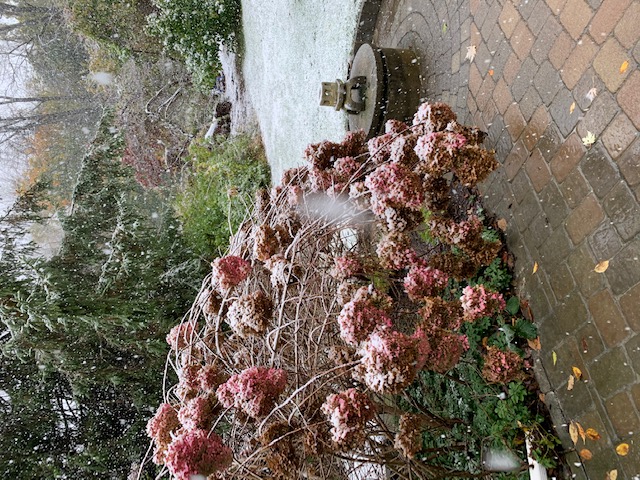
Posted in
Uncategorized
|
3 Comments »
September 29th, 2020 at 08:07 pm
Now that the stone facade and stair railing have been done at my house, I can finally say that the exterior of the house is pretty much DONE.
I will never have to paint anything on the outside again except for one little area that's visible in that photo of the side of my garage, by the big window. The trim on that seems to peel every summer.
Now I'd love to turn my attention to indoor projects, which are admittedly more important but more difficult and disruptive to my personal life to get done.
I have an older kitchen, but it's still functional. The priority there is actually to replace the ridge, which regularly (like today) malfunctions by suddenly getting freezing cold and ruining whatever produce I have in the bottom drawer and sometimes higher up. I also want to widen the space so I can get a bigger fridge.
The other project I've been thinking more about lately is redoing the upstairs bathroom. I have 3 goals there:
1. Replace the toilet, which sits really low. In preparation for me getting older (someone else's post here has got me thinking more of this again), it would be easier to rise from a toilet that sat just a few inches higher.
2. Replace the tub with a walk-in shower, the kind with a low or no step. I don't really need a tub but more importantly, I see it as an accident waiting to happen. It would be so easy to slip and fall in it, even now. I think a walk-in shower with a bench would be much safer and more practical.
3. Replace my cabinetry. UGH. It's very old laminate that is falling apart in places; it has 2 sinks, which I guess I'd replace too.
4. Another project, oh, I guess this counts as an outside one, would be to replace my front door. This is an old house, and the doorway is narrow, jsut 32" wide. Conventional doors today are 36" wide.I have struggled a lot to get furniture in here over the years.
5. Replace electric hot water heater. They only last so long, and it's about time for a replacement, which I'd rather do before it started leaking. I looked into getting an electric heat pump instead a few years ago, but I don't have the clearance for one in my basement with its low ceiling.
The problemw with the kitchen and bath remodels is that both would be pretty expensive and very disruptive. Aside from the fridge replacement, I'd love to get quality finishes in there, from the cabinetry to the countertops and backsplash. What I have now is laminate.
I'd probably want to do the bathroom first.
Totally unrelated: Someone today gifted me a beautiful albeit overgrown angel wing begonia. It was huge. I'd always admired them. I gave it a good pruning and have the stems rooting in water, so when they develop roots in about a month, I can offer them back on the Buy Nothing site. I just learned they are toxic to cats, so I'm gonna have to be real careful and keep Luther out of the bathroom, where I have the door closed.
Posted in
Uncategorized
|
4 Comments »
September 29th, 2020 at 03:52 pm
September was a very pricey month for me, mainly because I spent the max I've allocated for home improvements during any one year: $10,000.
I got my mason back here and he covered the ugly concrete garage wall (2 sides) with stone and it looks like an old country cottage now that's been like that forever, especially since my upper driveway is all done in pavers. (He did that too.)
What I especially like about the stones is that some of them still have lichens on them, so I'm hoping to encourage them to continue to grow as it makes everything looks so aged.

I now have 2 very nice seating areas: the back patio (same mason did that...I joke that I'm putting his kids through college) and the "side patio," which is actually part of the driveway to the left of the garage.

Those 2 tan metal chairs, incidentally, I got free from my Buy Nothing group. They had a bit of rust on them, so I used spray paint to redo them.
And that little stained glass table? Salvaged that at the dump!

Once I had that done a few weeks ago, I decided to just forge ahead and not wait til next year to replace the old wood garage door that had totally warped due to water absorption. I'm very happy with the final results.

On top of the home improvements, I had some other expenses that don't happen every month: $1310 for homeowners and auto insurance, an oil tank full-up to be ready for the cold weather, a trip to the vet and, for the first time in years, a quarterly estimated federal tax payment (just $96 this first time).
A few posts ago I talked about changing my pay structure for my job and going on retainer so I'd get the same pay every week for my p/t job.
Well, it seemed too good to be true and that didn't last! Three weeks into the new pay arrangement, the co-owner wife was covering for our p/t freelance accountant, who took some vacation time, and she came across my last week where i only worked 7 hours and was getting paid the equivalent of $100 an hour. Of course, no one said a word when I worked 7 hours or so for months and was earning about $150 a week, which was the whole reason I sought to stabilize my income.
They asked me to work additional hours to earn that fixed rate of pay they'd agreed to 3 weeks earlier. So now instead of working 18 hours (Mon/Tues/half of Wed), I'm now working a full day on Mon/Tues/Wed, or 24 hours instead of 18 to get the fixed rate we'd worked out.
It bothers me they reneged, yes (not very professional), but since I'm working from home, I'm willing to work the extra hours since the nature of how our business works is that I have tons of down time throughout the day when I can do other (personal) things.
Now, they decided to not renew the lease on the office bulding we'd been in back in March/April, but if they ever decide we need to all work together again next year,then I'll have to ask to switch back to an hourly rate of pay, because I'll be stuck on-site all 24 hours and not able to do anything else, so under my current fixed rate of weekly pay, my hourly rate of pay will have dropped substantially.
I made a return visit to someone I met through Buy Nothing to collect more goat, chicken and quail manure for next year's garden. I took this picture of my friend's cute ducks enjoying water sports.

Posted in
Uncategorized
|
7 Comments »
August 30th, 2020 at 12:39 am
I have a 12-year-old Whirlpool refrigerator/freezer, S/S, side by side with ice dispenser.
In the past year or so, it unexpectedly and without warning will suddenly turn cold...too cold...and ruin fresh produce in the bottom two drawers, or anything perishable like that in the lower part of the fridge.
I've had to throw food away as a result. I'm really unsure what to do. I really would like to get a substantially larger refrigerator, both taller and wider, as the one I have is pretty small. Its height is constrained by some cabinets above the fridge, and also by cabinets to the left.
If I wanted a bigger fridge, it would require some reconstruction of the cabinets, which I'm really not ready to do since the whole kitchen could use a makeover and it doesn't make sense to do it piecemeal.
Unless I just had someone (a carpenter?) take out the cabinets above and try to find a taller fridge, but not wider. Not sure how it would look though.

As you can see, to the left of the fridge is a cabinet and countertop, but to the right is a folding wood door with passageway to the dining room, plus there's a solid fixed wall, actually part of the cabinetry, on the right as well.
So I guess I'll just live with the unpredictable one I have now? I have it set at the near lowest setting in an effort to keep it from getting too cold. Not sure that's had any effect. I have a thermometer in there but will have to start paying closer attention to it.
Posted in
Uncategorized
|
7 Comments »
August 30th, 2020 at 12:03 am
Two days ago, around 5 pm, I was outside my fenced raised bed veggie garden trying to gain access to my collection of unruly tomato plants.
I heard a strange call...at first, it sounded like a bird, though not like any I had heard before. After a while, the sound seemed closer now, and low to the ground. I thought perhaps it was a fox, though I have had fox here in the past and they have more of a bark.
I stepped away from the very secluded area that is my vegetable garden (well, heck, my whole property is secluded), and peering through the foliage, I saw a bobcat about 100 feet away. It saw me around the same moment, and I noticed IT DIDN"T RUN OFF.
It occurred to me it could have rabies, so I figured I'd better go inside the house. I would have really freaked if it crouched and took a predator stance, the way that Luther does when he stalks something. I mean, it would have taken it seconds to reach me, and with my injured knee, I could go nowhere fast.
I decided to straighten up and not make myself look so small.
Once inside the house, I realized I'd left my cell phone on top of one of the fence posts. Darn! I had to go back down to retrieve it, but I grabbed a broom, just in case. The bobcat had disappeared from view, but could still be heard periodically calling, perhaps for a mate? Later, I heard it continue to call from the heavy thickets in my backyard.
I was relating the story to my friend and neighbor yesterdayy, and she mentioned she learned from talking to other neighbors that there have been multiple sightings of a bear in our neighborhood, along with a female bobcat with 2 cubs. That must've been her. Wow.
Kind of exciting and a little bit scary at the same time. I live pretty close to town, maybe a mile from Main Street. A bear was around last year, but I have yet to see it. I did see one at our town center where our municipal offices are located, along with our community center, sports complex, walking trails, etc.
Bear and bobcat sightings are not unusual in our town, which is very woodsy, but it is unusual in my paticular area which, as mentioned, is very close to town and is bordered by two 2-lane highways that are pretty busy.
A gardening friend of mine was over here the other day with his pole pruner, and he very kindly pruned a lot of branches on my mulberry tree, some of which were rubbing up against the side of the house, near the roof, every time there was a small breeze. So I was very glad he was able to do that for me. Having removed some of these lower branches really opened up the canopy and gives the appearance now of a parklike setting rather than just an overgrown tree.
I gave him 2 eggplants from my garden, which he'd told me he hadn't had success growing in the past. He's offered to return and work on my crabapple. September would be the perfect time to do it.
So I had a knocking noise in my Honda (rear) ever since the dealer put on 4 new tires for me. i brought it there TWICE and waited over an hour each time (outside for safety, but during heat waves, so each visit was like an endurance test) but they couldn't replicate the noise and were thus unable to fix it. I wanted to test drive it WITH them so I could demonstrate the noise, but they refused due to COVID concerns.
Their advice was to keep driving it until it got worse.
I felt uneasy driving it anywhere beyond the local area since I didn't know what the problem was and didn't want to break down somewhere.
So I finally brought it to the local Sunoco guy down the road from me and the mechanic there did drive with me (back seat, mask on, windows down). He heard the noise immediately and a few hours later, it was fixed ($118). It was some rust rubbing against the backplate of the wheel, or something to that effect.
I was kind of glad to have them do some kind of service for me I'd have to pay for, as I'm constantly over there due to low tire pressure warnings on my car and they always fill up the tires no charge.
Posted in
Uncategorized
|
1 Comments »
August 29th, 2020 at 03:11 pm
As I may have posted before, I've been working at home due to the pandemic since mid-March. I work p/t, but my hours have been dwindling since then, and in the last few months, I've averaged about 5 hours of work a week!
I finally decided to talk to my boss about it. I told him I needed to stabilize my income and just wanted to be paid what I was getting paid when working on-site, since I'm doing the identical job.
The big risk in doing so is that if they decided they wouldn't want to pay me more money, they could offer my p/t hours to my counterpart, who also works p/t during the latter half of the week.
Luckily, that didn't happen. After some discussion, he agreed that a retainer arrangement would work best for both of us, and they agreed to a fixed weekly payment based on 18 hours of work each week, regardless of how many hours I actually work. (I checked my average weekly hours for 2019, and it was 18.28, so I am right in the ballpark.)
This is wonderful! He said we want to make sure you feel like a valued member of the team. He had to talk to the co-owners of the company about it, and they gave it the green light. I also asked for a raise, noting that I hadn't asked for one last year, mostly due to my own oversight more than anything. I said since we're restructuring my job, this seems like a good time to address that, too.
And I got a 4% raise. So I'm going from $34.50 an hour to $36/hr.
I took this job 3 years ago. It was advertised originally as a temporary proofreading job, and I leveraged my background as a writer/editor to turn it into a kind of hybrid editor/proofreader job. If you consider it primarily editing, then I'm paid on the low side for this area and this industry, but if you consider it mainly a proofreader job, I'm paid at the top of the scale.
What's the difference between the two? A proofreader is not a writer. So they would confine themselves to fixing typos and punctuation. Hopefully grammar, too. An editor would do all that as well, but they also wouldn't hesitate to rewrite copy that lacks clarity, is redundant, confusing or not politically correct. They would correct for bad word choice and tone, and reorganize paragraphs of copy that don't flow right. Beyond the copy, I'm also checking formatting and making sure imagery and copy are in sync.
The important thing for me is that it has allowed me to pay the bulk of my expenses while working only 18 hours weekly. I had hoped to scale down to a p/t job as I approached retirement, but it would have been difficult to find a p/t job that pays this well. I have secured my retirement nest egg, paid off the mortgage and only need to pay ongoing expenses until I fully retire in 4 years' time at age 65.
So I went from worrying I could be entirely out of a job if they decided I wasn't worth keeping, to not only getting a guaranteed rate of weekly pay but a raise!
He also took my suggestion to finally cut the cord with the agency that found me, and which has been paying my paycheck for the last 3 years. I know they charge my firm more than double my hourly rate, so they've been making out royally while doing absolutely nothing. I have zero contact with them.
I'm very happy. The only thing remaining is that toward the end of our talk he indicated I'd still be treated as an independent contractor and I'd have to file my own quarterly tax payments.
This I do not want to do. I asked if they could take the taxes out for me, and he said to ask our (freelance) accountant, who works for our firm once a week. I hope this won't be a problem. I don't like that he said "ask her," since she shouldn't be the one making the decision, but only executing it.
I want them to deduct taxes for me and issue me a W-2 at year's end because it greatly simplifies things at tax time, not to mention I believe you pay higher taxes as an IC and I just want to minimize the number of tax forms I have to do. It also would make me ineligible for unemployment benefits should I ever lose the job. I'm really much more comfortable with a W-2.
My dad pointed out this arrangement could backfire on me should we get into one of our busy times, which is usually around the holidays. While that would have been true if this was still a full-time job (there were many, many late nights), I think the potential for that happening is fairly limited since I only work 2 full days (and 1 half-day) a week. So late hours could only happen on 2 days a week.
Posted in
Uncategorized
|
5 Comments »
August 16th, 2020 at 12:55 pm
Tropical Storm Isaias left many of us without power the week before last here on the East Coast. I prepped for the storm as best I could (no generator here) by turning my fridge/freezer to their coldest settings, charging up my phone and that's really it.
I lost power Tuesday at 2:30 pm. The wind was just ferocious.
I was praying I could save at least my freezer food, but alas, that was not meant to be. I planned to empty everything out of it Thursday morning, but my freezer began leaking water Wednesday night. I was just wrapping up downstairs and about ready to retire upstairs for the evening when I noticed a pool of water spreading on my wood kitchen floor. Thank goodness the floor is not level or I would never have seen pooled water under the fridge. It would have buckled the floor.
So I spent a good hour sopping up the water, pulling the refrigerator out and cleaning up, all by flashlight. It killed me to dump so much good food, and I had plenty.
I didn't do a whole lot more during my outage days. I lost a week's worth of pay since I lost my Internet. I ate very simply at home, eating lots of fresh produce from the garden and the occasional can of beans. I only ate out once, a pizza which tasted pretty darn good, and there was no sense to do more grocery shopping until power was restored.
Part of the outage took place during a heat wave, so it was sweltering here and difficult to sleep at night, though I still had my water so I'd take cool showers right before bedtime. I listened to my shortwave radio, and in particular 2 local stations, one of which did great updates on the status of the outage.
And I checked in on my 87-year-old father a few times, taking him out for ice coffee at Starbucks. My sister eventually got a generator but she ran it only a few hours a day. I have 2 neighbors with generators; one of them runs it 24 hours a day, so sleeping at night, windows open by necessity, felt like sleeping next to a truck stop.
Our attorney general has called on Eversource to reimburse people for lost food, but I'm not holding my breath. The power company has taken a lot of criticism for its slow response, especially when they had plenty of advance warning.
Injured Knee & Exercises, Striving for Fitness I am still doing my 3x a week exercising, plus my daily exercises for my injured knee. From what I've read, the vast majority of people with meniscus tears end up in the same place 6 months later, whether they do physical therapy or have surgery. In other words, surgery doesn't offer a great advantage unless you have a severe tear, and degenerative tears, caused by age, are difficult to repair. (I'm not sure mine is degenerative or not.) In addition, research has shown that surgery for meniscus tears inevitably leads to arthritis in the knee; trimming away the cushioning between the tibia and femur removes that cushioning for good. It doesn't grow back.
Functionally, I think my knee is doing fairly well. The only things I can't do is pull my knee up real close to my chest without pain, and walking long distance. Walking around the house is fine, because it's all level and I tend to take baby steps, not long strides, in my small home. What IS problematic is a great deal of stiffness in the knee and fluid buildup in one area. Is this the same as swelling? I don't know. I may see another doctor for a 2nd opinion now that time has passed, or I may give it more time.
So, I'm now at about my ideal weight (128 lbs), what I weighed in high school/early 20s! I attribute it to 24-hour fasts, once a week. I know I could easily lose a few more pounds, but choose not to. My clothes fit much better and I've lost a size. Ironically, there is no one to really appreciate it since I haven't been going out much.
The fitness center I joined last March suddenly began billing my credit card for the last 2 months. They had closed due to the pandemic but reopened, I think in July, but never informed me of anything. They agreed to freeze my membership at least til end of year, at which time I'll touch base and let them know if I want to continue the freeze or not. I wanted a refund of the 2 months they billed me, because as it is I'm already committed to a 12-month membership I signed up for when I joined, but they convinced me it would be too difficult to refund, they use a 3rd party biller, etc. etc.
I need to balance my desire for a perhaps more meaningful workout at the gym, as opposed to home, which is a priority since I learned I have osteopenia, vs. the virus exposures of working out at a public gym. I have been working out at home religiously, using exercises I've come across online specifically for bone health and women over 50, but it's hard to know if this will be enough or if I'm challenging myself enough, weight-wise. I'm using 5, 7, 10 and 12 pound hand weights, a weighted belt and weighted ankle things that will hold up to 20 pounds. Since my knee injury, I'm just using 5 lbs. now but hope to ramp up gradually.
I had a pandemic birthday, which mostly was a nonevent.
Posted in
Uncategorized
|
5 Comments »
July 27th, 2020 at 01:31 pm
...it's another. Or so I was ruefully thinking yesterday afternoon when at some point I realized my central AC had stopped working.
I changed the batteries in the thermostat. Flipped the switch on the breaker panel. Nothing.
Reluctantly, I called my HVAC guy and this morning when he called me back, he mentioned that the last time he was here, it was a matter of a small $2 fuse at a shut-off switch near the bottom of my basement stairs. I guess it's an emergency feature whereby I could shut off the furnace in case of fire, from a relative distance.
As soon as he mentioned the switch, I thought, oh my god, I've done this before. Paid a lot of money for a "service call" when all they had to do was replace the fuse. I had remembered years ago when this first happened to always keep a box of spare fuses handy.
I replaced the fuse and like magic, the AC compressor kicked on after a few minutes' delay. Now if I could just remember to check that darn fuse when either my furnace or AC isn't working! Can't tell you how often I've wasted money to have someone come to the house, only to find it's such an easy fix. It happens so infrequently, like every other year or so, that I totally forget to check it. Sigh.
I may mail that guy a Starbucks gift card as a way to say thank you.
As far as my knee rehabilitation, I finished up my 6 weeks of physical therapy last week. While I have improved, I'm nowhere's near 100% fine. If it wasn't for today's heat wave, I would try walking a greater distance on it, which I haven't done in months. Walking around the house is fine, but I feel it when walking, say, from car to supermarket. The knee is still quite stiff when I try to bend it (I think it's the swelling), but I can now fully extend it about 95% straight.
Since the physical therapy ended, I felt like I lost my security blanket. The therapist suggested I return to see the orthopedic surgeon as to possible other options, but I wasn't crazy about the surgeon and I know he's going to be biased toward surgery, which is what he initially suggested to me after a 5-minute exam of my leg.
The therapist also indicated it would not be unreasonable to continue my at-home exercises for the knee and give it another month or two. Which is what I'm doing. I also decided to double the daily exercises, so instead of doing just one daily session, which takes about 20 minutes, I'm doing the exercises in the morning and again at end of day. They aren't that strenuous but focus on building back strength in knee.
On top of that, I am still doing my "regular" strength training workouts 3x a week, which I began last spring to combat osteopenia, and after the gym I joined closed due to the virus.
So I often feel that all I'm doing is exercise, exercise, exercise! I'm just not getting any cardio now, though, so I'd really like to venture out onto my street again and see how walking goes. I know I need very well padded shoes. I may only be able to go a few hundred feet. I'm not sure. I talked a lot to my therapist about how much exercise is right...he said not too much that you set yourself back, but doing too little is also a very bad idea because muscles atrophy quickly. If anything, I tend to overdo it.
I'm trying to be patient as I've been told the knee has very little blood circulation and that's why it takes so long to heal; the red blood cells can't get in there. Also why the swelling in my knee is still there; the fluid builds up when injured but has no way to exit once there. Only slowly, over time.
Garden news: I've been regularly picking zucchini, and to a lesser extent, eggplant, cucumber, kale and stringbeans. I have about 4 small butternut squashes developing (!), but the squash plant has escaped the confines of the raised bed and sprawled all over the fenced raised bed area, making it really hard to get in there with a hose to water, especially the downward slope and my injured knee. Plus I damage the squash plant's leaves trying to thread the hose in and around it.
Yet I must water daily as this heat has been horrible. Now the vines have gone through the fence and are crawling around my lawn. I'm surprised the deer or something else hasn't discovered them yet and chewed them all up.
I did plant some asparagus bean (also known as yardlong bean) in a pot to grow up a tent frame I have on the back patio. It got going kind of late because it won't germinate until it's really pretty warm. But it loves all this heat and it has begun to really look healthy and take off. But still no signs of flowers, so I am really hoping I get to experience the 18" long beans. Same goes for the louffa sponge plant I'm growing. It's still climbing, but no flowers yet. Only maybe 6 more weeks of reliably hot weather left in the season.
Of course, I'm still waiting for the Big Kahuna: ripened tomatoes!!!! That's what I'm living for. I love blanching and freezing my surplus for winter use in soups and stews. I'm so afraid a blight or fungus is going to wipe them out before that happens, because my huge tomato plants all flopped over, in their cages, and are somewhat resting on the top of the 6 foot high perimeter fence. I can't even access the plants anymore to really thoroughly water them, and if I tried straightening them out I know I'd damage the branches.
I'm working very few hours these days, averaging probably 5 hrs a week the past 2 months. Work has become more of an afterthought than something to shape the rest of my schedule around.
My one remaining freelance client did send more work my way...from his wife, who works in the entertainment industry. I hope it becomes a more regular thing.
I continue to give and get things from my local Buy Nothing group. This morning I picked up someone's old bowling ball, which I thought I could spray paint in a metallic silver or gold and hopefully balance on an old birdbath pedestal I have (the basin broke years ago).
I also picked up a small plastic folding outdoor table and was offered a wood bunkbed ladder, which I thought I could repurpose as a trellis for pole beans next year, but I'd have to find a way to support it somehow.
I recently gave away a cross-body bag, many rolls of tape and several career books.
Posted in
Uncategorized
|
4 Comments »
July 14th, 2020 at 09:33 am
I'm going to have to cut my own hair.
Someone else here mentioned they scheduled some haircuts, but I'm not ready to venture there yet. It's long overdue and my hair is longer than I like it, but gosh, the haircutter has to stand so close to you, breathing down on you as you sit there....I just can't go there yet. I'd sooner hack at my own hair and if it's crooked, so be it. It will grow out again.
I used Instacart for the first time yesterday. (See my separate post on that.) I loved how it worked, but I think it has limitations Frozen/refrigerated foods would probably melt by the time I got them, and while it would be great in a pinch, I would rule it out for any kind of routine use due solely to cost.
At a social level, being a single person who lives alone, I'm about at my breaking point. I've been working remotely (extremely p/t) since mid-March, and the only people I have seen since then, sporadically, have been my father and 2 neighbors I am friends with. My one neighbor has been trying to cajole me into doing things with him, but even when wearing a mask, I find it a little hard to justify doing so when the risk remains.
He tells me he wishes I were a risk-taker, and I tell him there's a difference between taking risks and being prudent.
One outlet for me has been the Buy Nothing Facebook group in my hometown. I joined a few months ago and it's become a form of entertainment. I've given away tons of stuff on that site, but also gotten some very nice things in return, and these are not junky items. Many people generously give away brand new, never used items of all kinds.
I urged my 2 neighbors to join but now the group has gotten too big and is closed to new members. I do love that it's just people who live here; it feels a lot less anonymous than making a Goodwill donation, and I love driving the many backroads of my town, down streets I've rarely traveled, to pick up my finds. Sometimes I chat a bit, at a distance, with the giver if they're around, but more often than not, the item is simply left in a designated place for pickup.
The biggest frustration, as someone who is giving something away, is that many people who say they will be there on such and such a day to pick up don't show up. So then a storm comes and you have to run out and bring the item(s) inside so it won't get ruined. People take their time picking stuff up, which I think is disrespectful to the person making the gift. I always state "Prompt pickup appreciated" in my posts, but that doesn't seem to have much impact.
Among my favorite items that I've gotten: a set of 6 brand new vintage linen dishtowels. A round glass tabletop I paired with a rattan luggage rack I have to make a funky table. A vintage lamp that would look at home in the Adirondacks with its handpainted shade of geese flying across a mountain backdrop. And a nearly full, 25-pound bag of organic hulled barley (!) that someone had bought to feed their dogs, but it didn't agree with them. I filled up every glass food storage container I had in the house with it and shared the rest with my sister and friends. It won't go to waste!
In turn, I have given away a very well-made rocking chair with my college insignia on it...in truth, it seems quant and old-fashioned, and my style runs more to modern. I've had it for 40 years and it was time to let it go. Kind of took up a lot of space I don't have here.
I also gifted several 35 mm cameras and some very expensive (in their time) long angle and micro lenses. There was a time I loved using these, but once I got my digital camera, and later, my iPhone, well, the quality is great and I don't see myself every going back to 35 mm. Another popular item I gave away was a full-sized extension ladder I didn't think I'd use anymore. The catch was, it was jammed in my small toolshed. I had somehow wedged it in there and remembered difficulty trying to get it out since. No worries, there. The guy who wanted it happily came over and managed to get it out of the tool shed.
Around the same time I joined the Buy Nothing group, I joined a local Facebook gardening group. It's a much smaller group, just a few hundred members. While that site isn't solely dedicated to giving and getting stuff, a bunch of us were doing so earlier in the spring, and I got a ton of vegetable and flower seedlings, as well as seeds, through that site. In fact, I only bought 1 cucumber seedlings and 2 eggplant seedlings from our local farm; everything else I have in the raised beds was gifted.
I've gotten to know a few of the other members, and several of us have been talking about the possibility of doing garden tours or even just a BYOB event at someone's patio once the pandemic settles down.
Actually, my state of Connecticut is doing very well now as far as that goes. Earlier on, of course, we were one of the hardest hit, along with New York, but since then, people have largely been taking it seriously and taking all the right precautions.
Our governor, I think, has done a very good job of steering the course, although I think I will disagree with him for the first time on 2 issues: 1. His idea to request a voluntary 2-week self-quarantine of anyone who arrives here from something like 17 different states deemed to have a high number of virus cases. My thought is that people won't voluntarily self-quarantine and we'll end up seeing a resurgence of the virus here as a result.
2) Governor has decided schools will reopen in the fall. I know this is vitally important, yet I don't see kids, especially the little ones, complying with face mask requirement and social distancing. This is really problematic, and I think a lot of parents agree with me on this.
Posted in
Uncategorized
|
8 Comments »
July 14th, 2020 at 08:29 am
On a whim, I decided to try using Instacart for the first time yesterday to save a trip to the grocery store.
I've avoided one of my favorite stores, Aldi's, since mid-March because I didn't like the idea of brushing past other shoppers in their narrow aisles. So when I saw they made home deliveries by partnering with Instacart, I jumped on it.
I have to say, the Instacart interface worked flawlessly, was a breeze to use and offered way more flexibility than I'd anticipated.
I downloaded the free Instacart app on my phone, which provided some conveniences I'll describe later, but I placed my order on my desktop computer.
I took my time browsing Aldi's products on the Instacart platform, which were organized by type (bakery, frozen, fresh produce and so on). I decided not to buy any frozen or refrigerated items because I was worried about how long it would take to get the delivery, and we've been having temperatures in the 90s here. So I settled on about a dozen items, mostly fresh fruit and a few other items.
My total, Instacart told me, came to $34.66.I was able to choose a day and one-hour window for delivery. I chose 7-8 pm on the same day I ordered because I knew I would be home and I was hankering for some watermelon.
After placing my order, Instacart let me know I still had time to amend my order with either additional items or to delete anything I wanted. That's when I deleted my refrigerated hummus, and Instacart instantly deducted that from my total bill.
Since I had loaded the Instacart app and given permission for them to text me updates, I got my first update about an hour before expected delivery, informing me that "Courtney" would be my shopper. I had already indicated when placing my order whether I would accept a substitute for an item should it not be available, or whether I'd prefer a refund, and I could watch in real time as Courtney made her way through my list and then made one or two substitutions of items, as well as one refund.
Courtney sent me two brief texts, the first one saying she couldn't find the golden kiwis and the last one indicating she was stopping for gas and then would be headed my way. I could actually track her progress with GPS and watch as she traveled rom Aldi's to my home (!) so I knew exactly where she was and when she'd be here. Amazing.
She arrived here on time and was so pleasant that I sent her off with two zucchini from my garden. As it turned out, she lives in my hometown, had been planning on running to Aldi's for her own family and decided to do an Instacart run while she was there. I'm pretty sure Instacart part-timers get paid a flat fee for each customer order they fill.
Courtney did make one small mistake: I had ordered a box of green kiwis ($4.09) and a 2nd box of golden kiwis ($3.29). While she was shopping, she indicated via the phone app that she couldn't find the golden kiwis and refunded me for that item. When she got here, she told me she DID find the golden kiwi, and I saw after she left that I was missing the green kiwis. But the refund I got was for the golden kiwis. (Note to self: Keep it simple.)
I loved the entire customer experience. Everything worked really well. But there was the matter of the price. I've shopped Aldi's for several years, and when I scanned the Instacart itemized list of what I'd bought, the prices seemed higher than expected. I kept wondering if Aldi's had increased its prices since the last time I had been there.
Courtney left the Aldi's receipt with the food. (Instacart later confirmed this fact with an actual photo Courtney had taken of my front steps with the food sitting there), and it was then that I realized Instacart pads the price of each and every individual item you purchase. I'd assumed they'd charge me a delivery fee (they didn't, I think because this was my first time) and a service fee for the driver (they did), but I didn't consider they'd inflate the price of my food.
So I could see that Aldi's charged me a total of $24.02; my Instacart total, as mentioned above, was $34.66. A difference of $10.64 may not seem like much, but that's actually a 44% increase! It kind of defeats the purpose of shopping at a cheap grocery store like Aldi's.
Aldi's had NOT increased their prices. But, for example, Instacart had charged me $5.49 for a whole watermelon that Aldi's wanted only $3.29 for.
If I planned to avoid grocery stores entirely during the pandemic, well, this just wouldn't be feasible, and would have inflated the nearly $5,000 I spent on groceries last year to $7,200! (Yep, I spent a lot of money on food, and I don't even eat meat.)
I could see the value of using Instacart in certain unusual situations, like if you were home recovering from surgery and couldn't get around. Otherwise, it seems like a very pricey, but seductive, convenience.
Posted in
Uncategorized
|
3 Comments »
June 17th, 2020 at 12:54 am
It's spring, there's a ton of stuff to around home and garden and the last thing I want to do during a coronavirus outbreak is to see a doctor.
But I've been doing quite a bit of that lately.
Out of the blue, I had a scary issue with first seeing a very large, dark floater in my right eye, and hours later, I started seeing flashes of light.
I saw my ophtmalogist, who performed a very uncomfortable exam of my eye and told me the good news was that my retina was not detached. Yeah, retinal detachments can happen if you get punched in the eye or are in a car accident, but they also happen purely as a function of age. The vitreous fluid behind the eyeball is a jelly-like substance that sometimes shrinks with age; most of the time, that's all that happens but if it shrinks enough, it can detach from the eyeball.
I have to go for a follow-up on Friday for another painful exam where it felt like he was trying to push a small round cup through my eye socket. Doc informed that if this happens to one eye, you have a 90% chance of it happening to the other eye within the next 3 years, and it's important to get to the doc ASAP because they only have like a 48-hour window to reattach a detached retina if that happens.
The more challenging health issue is that I have a torn meniscus, the c-shaped ligament around the knee. Seems I have torn both the medial and lateral sides. This happened back in mid to late April, but I didn't pay attention to it as I should have. I thought it was another pulled hamstring, something I did 5 years ago. As best as I can tell, I tore the meniscus while working out at home, most likely when I was doing a modified plank. I vaguely remember feeling my tendons in the back of my leg stretch like a rubberband as I held myself on my forearms and toes doing essentially a push up.
At first I thought it was getting better, and then it wasn't, and then I thought it was improving, and then it didn't. This went on for weeks until I finally saw an orthopedic surgeon. Well, first I did a phone call and showed him my knee on the phone, but I guess that wasn't really adequate. I did an MRI and then saw him in person. The meniscus tear is complicated by an old injury I had on the same knee that tore the ACL. That was in my 20s, when my boyfriend was teaching me tae kwon do and I twisted the knee bad, although strangely, I don't even remember seeing a doctor for that injury.
The doctor has suggested surgery...not surprising since he's a surgeon, but as far as I can see, there are no orthopedic doctors who aren't also surgeons, so there's going to be a built-in bias toward surgery.
I've asked to try physical therapy and am praying that helps. My first session is tomorrow in a private room.
I'm still working from home, and there's been ZERO communication from my manager or the owners of the company about what, if anything, is going on or what the plan might be. I mean, I haven't heard from them since prior to March, when I began working from home. I only average 5-7 hours a week but have to hang around the house 20 hours a week during my scheduled days to be available if they need me. Doesn't strike me as fair since I don't get paid for waiting around.
But I'm a contract worker, and that's what the agency said is how it works. Bill only for actual hours worked.
My health issues are really having a big impact on my dad. Usually I'm there every week, doing light housekeeping, buying his groceries and taking him out to lunch and a drive usually, sometimes the barber shop and so on. I can't do any of that now though I still have been visiting.
I've been restricting my food shopping to mostly BJs because it's a huge store and I can keep my distance from people, but now with my knee it's all too much walking, so I may switch to Shop Rite. The little stress like Aldi's and Trader Joe's make me nervous.
My raised bed veggies seem to be doing mostly well. There's a teeny zucchini growing. Tomatoes grew great but there's some leaf shriveling going on which I'm fairly sure is grubs; I applied some milky spore but it takes time to have an effect. My cucumber plant also now a some flowers, which I hope to hand-pollinate tomorrow. I'm training it to grow up a plastic fence I've tied to a tent frame on my back patio. At each of the 4 corner posts there is cucumber, asparagus bean and luffa plant.
I've been eating tons of arugala and kale, which is even more crisp-tender than what I get at the organic farm in town.
In other health news, I finally reached my target weight of 130 lbs, which is just 5 lbs more than what I weighed in my 30s, I think. It's a good weight for me and my clothes fit better. The secret to my weight loss is very simple: 24-hour fasting.
It definitely requires some mental preparation the day before the fast, but it's not so horribly difficult as you may think. Hunger comes in waves; it comes and it goes. It does not get progressively worse as time goes on. What motivates me is reminding myself why I am doing it. (Weight loss was not my primary reason.) Fasting offers a wide range of health benefits, but the most valuable one to me is autophaghy.
Even if you totally pig out after the fast, you will still lose weight. It just seemed to happen without really trying, although I do tend to have a very healthy diet.
I am really hoping to learn a lot from the physical therapist tomorrow about what he thinks my outlook for recovery sans surgery is. I did not get this from the doctor. Five minutes is about what I had with him, and even though I had my list of questions, well, they didn't get answered. One specific question I had was what grade tear are they (as grades 1 & 2 may not need surgery, while 3 does). And I still didn't get an answer to that; he went off on some tangent. I'm thinking I don't have a Grade 3 tear since I imagine that would be much more painful.
Posted in
Uncategorized
|
8 Comments »
May 29th, 2020 at 06:02 pm
Spring can be a VERY busy time of year around here. Unfortunately, I pulled a hamstring a month ago, mostly ignored it and as a consequence it really hasn't improved much. My knee is incredibly stiff. Yesterday was really the first day I tried to do as little walking on it as possible, and today I'll do the same, but tomorrow will be a good weather day and I REALLY need to install the hardware cloth on the bottom of the 2nd raised bed and fill at least half the raised bed with my remaining seedlings. (Plus I've been mowing my own lawn.)
I didn't like the quality of the top soil I got for the 1st raised bed, so this time I'm actually thinking of finding a relatively bare spot in my yard and digging up a few wheelbarrows' full of dirt (with my pulled hamstring). I also bought 3 bags of organic Black Kow manure, along with a bag of organic fertilizer.
I've also been having a lot of fun offering and getting stuff on two hyper-local Facebook sites: one is a Buy Nothing group and the other is a local gardening group where I've given away a ton of cosmos seed and also gotten free seedlings of chives and leeks, and also arugula and Jerusalem artichokes. I've also gotten some French bean seeds and a bunch of different flower seeds. So much to plant, including some elephant ear bulbs I saved from last year.
I'm happy to report the lantana plants I tried to overwinter in the back of garage last winter survived, and are growing now.
I did my monthly investment report and was surprised at how much the market has rebounded since the coronavirus began. My portfolio's almost back to where it was. However, I was fairly conservatively invested with only about 45% stock exposure. So my losses weren't as deep to start with.
I've decided to move forward with 3 home improvement projects, all masonry-related. One is installation of a handrail (the kind that doesn't rust or rot) on my front stairs, very important for my dad, as well as myself and any visitors.
The 2nd is to cover the façade of my ugly cement garage walls (one side and front) with stone veneer to match all the other stone walls/stone work surrounding driveway area. I've wanted to do this for years. It will really look amazing and cover up what I consider an eyesore, 1st thing you see when you pull up the driveway.
Finally, the 3rd project is redoing/rebuilding one concrete wall inside my basement. I think there's a name for it, but basically the old concrete is deteriorating/disintegrating. You can scrape it with a fingernail and it will flake off. I don't know extensive it is and hope it's more cosmetic than anything, but feel it's something I need to address, most especially if I ever sell this place (which I don't plan to, at this point).
I don't have a start date yet but we did agree on price; I need to clear off the old workbench in the basement to get stuff out of his way but I figure I have some time as I asked him to do the other jobs first. They are both outside, so it should be easy to minimize contact.
I recently sold a bunch of succulents on Facebook for $50; I just wanted to clear away some excess plants because things are getting too cluttered here, and truth be told, at least one of these plants, a Euphorbia Horrida, while alive, has grown very little in the 2 years I've had it (!) and I'm losing interest in it/them. I also sold a propeller plant, a lime-green pothos, and a small copper spoon.
I took an idea that Dido mentioned and RAN with it...earlier on, when toilet paper was hard to come by, I latched onto the idea of using a portable bidet in the bathroom, cutting down drastically on my use of TP (only use now for #2), and the need to buy it. I bought about 50 hotel-style washcloths pretty cheaply, like $24, and they're still too large for my needs, so I cut them in half to reduce the need for laundering them (just throw in some bleach). However, since they're like a terry cloth material, I found they unraveled quite a bit in the dryer, so I've begun the rather tedious process of sewing a hem on each one. This will take some time, but that's something I have plenty of these days!
I guess my survivalist neighbor is rubbing off on me. I don't think he uses a bidet, but I really like the idea of not having to depend on store-bought toilet paper. He's got about 30 raised beds to grow veggies this year, plus a bunch of fruit trees, a cow for milk, 2 calves for meat, a bunch of chickens and a bunch of sheep. Plus 3 freezers. He says he could eat for 2 years if the severe food shortages he believes are coming materialize this fall.
Posted in
Uncategorized
|
2 Comments »
May 7th, 2020 at 06:41 pm
It's been a busy month or so.
My neighbor finished building my raised bed, and he also fenced it. It's a 15-foot square area that will nicely fit a second raised bed, which he said he could do this week.


I found a natural wood sealer that is safe to use with raised beds and had to wait a week for the rain to stop before I could use it. You only need to apply it one time. I have plenty left over and plan to use it on the 2nd raised bed. .
So far, I've spent $437 on this. The most expensive item was the cedar wood used for the bed itself. Getting the 2nd raised bed in should cost me another $216, not including soil. I'm hoping that with the sealer, the bed(s) will last at least 4 years, if not longer. I did talk to one person who said her cedar bed only lasted 3 years, but I don't think she used any kind of sealer on it.
I also made a simple compost bin out of a large Rubbermaid storage container. I used my drill to make lots of holes in the side, top and bottom for ventilation. I had a yard of topsoil delivered, but I don't think it's very good soil I should have stopped in to check it before ordering), so I'm working to amend it. Neighbor give me chicken and sheep manure and I bought some organic fertilizer, plus some compost I got for free. You can see the bin inside the fenced area.
We've had an exceptionally chilly spring so the only thing I have actually planted thus far are 2 small kale plants I got from my local organic farm plus some small broccoli which were already flowering. I also planted arugula seed, which has come up but is tiny.
I have lots of veggie seedings in peat pots being nurtured indoors: cherry tomato, beefsteak tomato, and red pepper. They're in the sunniest room in the house, my upstairs bathroom, and so to harden then off in preparation for their going outside next week I hope, I found it easy to open the bathroom window that looks out on my family room roof, which is not that steep. I put the seedlings out there, knowing they're getting lots of sun and are protected from curious chipmunks who go for tender new foliage.
I gave up on some other seeds that require exceptionally warm temps to germinate, like the cucumbers, asparagus bean, eggplant and louffa sponge. I'll try sowing directly outside, but am concerned I'll be way behind schedule, so I bought 2 eggplant from my local farm. The beans grow fast, so they should be okay. I'd like to snag a cucumber seedling somehow; local stores seem to be out of everything. Am getting a free celery plant today from Buy Nothing.
I have red poppies growing in the garage.
I picked up 3 small peppermint plants for free from my local Buy Nothing group. My neighbor said he has lots of extra veggie seedlings so hope to get a few potato plants and maybe basil from him. I'm giving him some perennials.
His work for me was part of a barter arrangement; in return, I'll be writing/editing a set of playing cards, each one to feature one of the characters from his children's fantasy book. I did the first one today. All of the characters are insects.
A pair of gobblers (male/female) has been wandering around my backyard for a while. Or I should say, the female wanders aimlessly (who knows what she is thinking?) while the male follows wherever she goes. Alas, she seems oblivious to his fan displays.


The hummingbird(s) is back, and recently I saw a yellow warbler and a Baltimore oriole in the yard, along with scat I suspect is a fox. Also spotted a very pudgy (pregnant?) opossum trudging along.
Posted in
Uncategorized
|
4 Comments »
April 10th, 2020 at 11:22 pm
I am waiting for the weather warmup, which here in the Northeast, will happen on Easter Sunday, when we'll see a high of 58 degrees.
That's when I plan to do some seed planting: I've started red peppers already, and I plan to do eggplant, broccoli and butterfly weed in my little peat pots. I really have an extreme shortage of indoor space, and just a limited number of grow lights in a cool house, but I'll figure something out. To hedge my bets, I will reserve a certain number of seeds for direct sowing in the ground when it's warm enough. I have soooo many flower seeds collected since last fall through several different seed exchanges.
Aside from wishing cousins and dad a Happy Easter, this will be the highlight of my Easter. No special dinner planned, but I will go out for a nice long walk alone.
Update on neighbor's tenant, who has the virus. She's hanging in there. He's checking her blood oxygen levels twice daily and knows what would signal he needs to call 911. He told me it was very hard caring for someone that sick; you feel for them and are scared for them, he said, and she should be in the hospital. He can't leave her for more than a few hours.
This morning I was able to pick up 4 wood pallets from behind a shed on town property, near our walking trail. I had already gotten the permission of the First Selectman. It kind of tickled me that I live in a town where the First Selectman still has time to personally respond to your email query and give you his blessing.
I plan to build an insect hotel; they are quite popular in parts of Europe.


Sure, you can buy them, but they are overpriced and very small, and frankly, half the fun is filling it with all sorts of organic materials.
So I will stack the pallets, as shown in the 2nd photo, and maybe use some bricks in between pallets for some extra height.
Posted in
Uncategorized
|
2 Comments »
|